Salmon peptides, explained
Search "salmon peptides" and you'll get pink K-beauty serums, viral "salmon sperm" facials, collagen powders, and a quiet line of metabolic research — all wearing the same name. They are not the same thing. This is the honest, cited field guide that sorts the four different products apart, shows what each actually does, and tells you where the real science stands.
"Salmon peptides" is one phrase used for four unrelated things: (1) topical salmon PDRN / "salmon DNA" serums you rub on your skin; (2) salmon collagen peptides you drink for skin, hair, and joints; (3) salmon protein hydrolysate — bioactive peptides taken by mouth, studied for metabolism and GLP-1 signaling; and (4) injectable polynucleotide "skin boosters." Same fish, completely different molecules, uses, and evidence. Below, each one — sorted, sourced, and straight.
On this page
Why "salmon peptides" is suddenly everywhere
Two waves collided. On the beauty side, Korean "PDRN" skincare — fragments of DNA purified from salmon — went viral, and "salmon DNA" and even "salmon sperm facials" became search-engine catnip.7 On the wellness side, researchers began publishing on ingested salmon peptides and how they interact with the body's own metabolic hormones, including GLP-1 — the same pathway behind today's weight-loss drugs.18 Because both use the phrase "salmon peptides," they crash into the same search results. Most people never realize they're looking at four different products.
"Same fish, four different molecules. If you don't know which one you're reading about, you can't judge whether the claims are real."
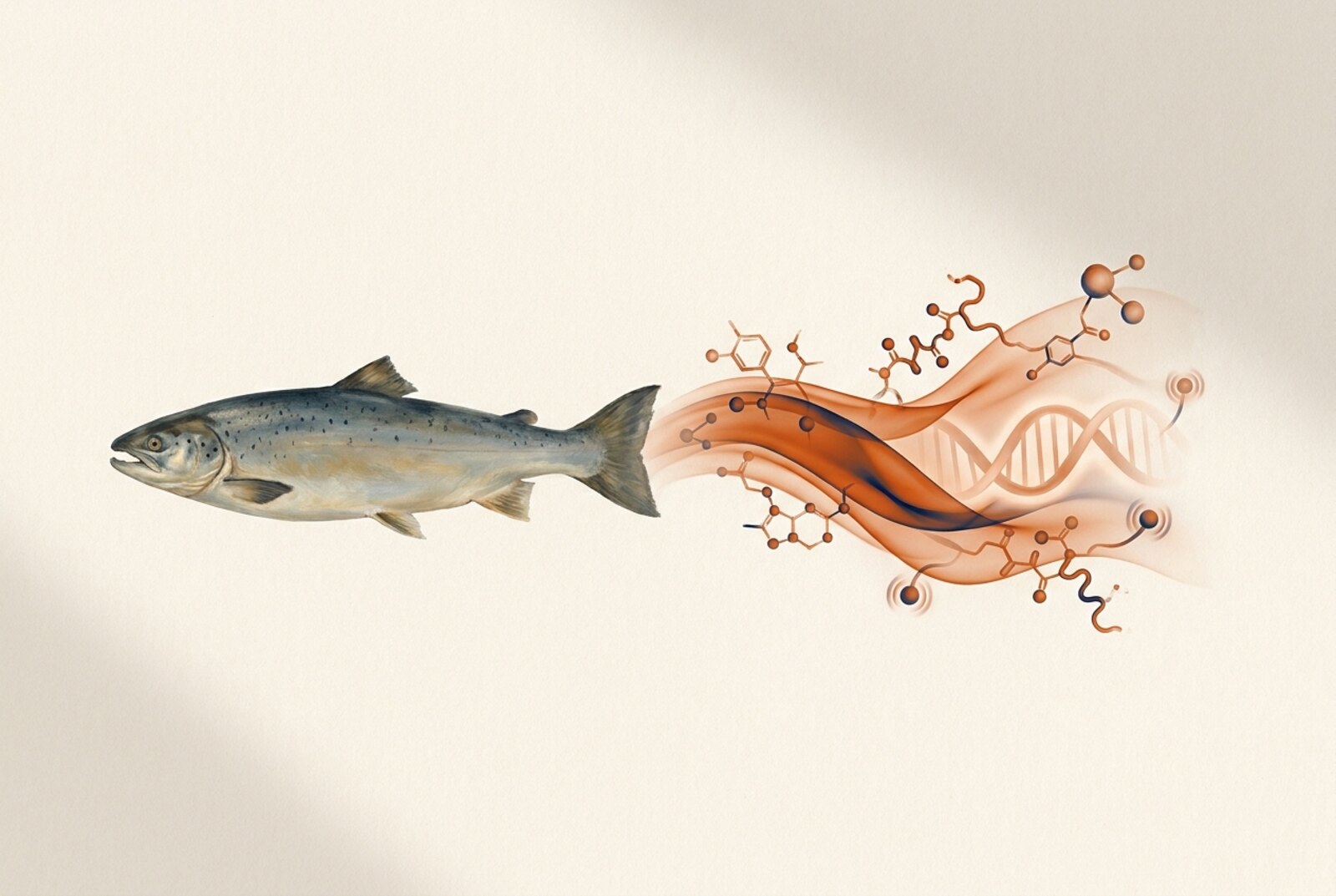
One name, four different things
Here's the map. Everything called "salmon peptides" falls into one of these four buckets — and the differences matter enormously for what it does and what evidence exists.
The critical takeaway: a topical PDRN serum and an ingested protein hydrolysate share almost nothing except the word "salmon." Different molecule, different route, different purpose, different evidence base. Anyone comparing them head-to-head is comparing apples to submarines.
The product landscape
A snapshot of real products across the four categories, so you can see who sits where. (Prices are approximate and change; links go to the makers or retailers, not to us — this table is a map, not a recommendation.)
| Brand | Product | Category | Route | Headline claim | Approx. price |
|---|---|---|---|---|---|
| Medicube | PDRN Pink Peptide Serum | ① PDRN | Topical | Firmer, more elastic skin | ~$26 |
| Rejuran | Turnover Ampoule C-PDRN | ① PDRN | Topical | Post-procedure repair | Premium |
| VT Cosmetics | PDRN 100 Essence | ① PDRN | Topical | Plant-based "vegan PDRN" | ~$20 |
| Vital Proteins | Marine Collagen | ② Collagen | Ingested | Skin, hair, nail, joints | ~$39 |
| Wellbeing Nutrition | Korean Marine Collagen | ② Collagen | Ingested | Low-molecular-weight, absorbable | ~$40 |
| Hofseth BioCare | ProGo (ingredient) | ③ Hydrolysate | Ingested | Metabolic & GLP-1 research | B2B ingredient |
| Rejuran | Healer / PN skin booster | ④ Injectable | Injected | Skin regeneration (clinic) | ~$499+/session |
// Categories: ① topical PDRN skincare · ② ingested collagen · ③ ingested protein hydrolysate · ④ injectable polynucleotide. triGLP sits in ③.
Topical PDRN & "salmon DNA" — and the "salmon sperm" question
PDRN (polydeoxyribonucleotide) is a mixture of short DNA fragments. In skincare, that DNA is most often purified from salmon milt — which is why you'll see the eyebrow-raising "salmon sperm facial" headlines.7 To be clear: it's purified, fragmented DNA, not cells — on an ingredient label it appears as "Sodium DNA." It's marketed for skin elasticity, barrier repair, and a post-treatment glow, and it shows up in serums (Medicube, VT), premium ampoules (Rejuran's home line), and — as longer polynucleotide chains — in in-clinic injectables. This is topical or injected skincare. It is not a supplement, has nothing to do with weight or metabolism, and is a completely separate story from the ingested peptides this site is about.
Salmon & marine collagen peptides
The second ingested category is marine collagen — hydrolyzed Type I collagen from fish skin and scales, sold as a powder. It's studied mostly for skin, hair, nail, and joint support, and there's a reasonable body of research on marine collagen for skin aging and wound healing.910 Important distinction: collagen peptides are structural — building-block amino acids for connective tissue. They are a different thing from the bioactive metabolic peptides in salmon protein hydrolysate, which are studied for signaling, not structure. "Salmon collagen" and "salmon protein hydrolysate" are not interchangeable.
Salmon protein hydrolysate — the metabolic one
This is the category triGLP belongs to, and the one with the least hype and the most interesting science. Salmon protein hydrolysate is whole Atlantic salmon protein broken by enzymes into small, readily-absorbed bioactive peptides. Certain of those peptides do something beyond nutrition — in laboratory work they interact with the body's metabolic signaling.1 The best-characterized example is ProGo from Hofseth BioCare, the ingredient with the published human and laboratory research below. We cover this ingredient in depth on its own page: what salmon protein hydrolysate is.
What the science actually says
Here's the honest state of the evidence for the ingested, metabolic salmon peptides — because this is where the hype and the reality drift apart, and being straight about it is the whole point of this page.
The laboratory (in-vitro) findings
- GLP-1 & GIP receptor activity. In cell studies, a soluble salmon protein hydrolysate activated the body's GLP-1 and GIP (incretin) receptors, and the smallest peptide fraction was the most active.1 A separate study found salmon peptides inhibited DPP-IV, the enzyme that breaks GLP-1 down.2
- This is the finding the headlines are built on. When trade press wrote "salmon-derived peptides may activate GLP-1,"8 that may is doing real work: the receptor activity was measured in cells, not in people.
The human trial — and exactly what it did and didn't measure
There is one published human trial of ProGo: a 56-day, randomized, double-blind study in 14 overweight adults, comparing 12 g/day ProGo against an equal amount of whey protein.3 This is the honest breakdown:
- What it measured and found: improved body composition versus whey — lower body fat (about −10.7%), lower BMI (about −7%), reduced waist, with lean mass preserved — plus better iron/blood markers (ferritin up ~13%) and a modest glucose improvement.3
- What it did not measure: the trial did not measure GLP-1 in participants, and the one appetite hormone it did track (ghrelin) did not change significantly. So the human trial does not, by itself, prove a GLP-1 or appetite effect — the GLP-1 story rests on the separate laboratory receptor work above.
- The limits: it's a small pilot (n=14), the comparator was whey rather than a placebo, and the manufacturer was involved. It's genuinely encouraging and hypothesis-generating — not confirmatory proof.
That's the accurate version. The ingredient shows real, specific laboratory activity on the GLP-1 pathway, and a small human pilot shows real body-composition changes — but "activates GLP-1 in your body" is not something any published human trial has shown yet. We'd rather tell you that than sell past it.
Side effects & who should avoid
Across every category, the single most important consideration is simple: these come from fish.
- Fish / shellfish allergy is the number-one reason to avoid salmon-derived products of any kind — topical, ingested, or injected. If you have a seafood allergy, don't use them without medical guidance.
- Pregnancy & breastfeeding: data are limited across these ingredients — check with a clinician first.
- Topical PDRN: generally well tolerated, but patch-test; occlusive formulas can bother acne-prone skin.
- Injectables are a medical procedure — that's a conversation for a licensed provider, not a shelf purchase.
- Ingested salmon peptides are a dietary supplement, not a medicine — they don't treat, cure, or prevent disease, and they don't replace prescription GLP-1 drugs.
Where triGLP fits
Stated plainly: triGLP is in category ③ — an ingested salmon protein hydrolysate dietary supplement, built on the exact bioactive-peptide family in the research above. It is not a PDRN skincare product, not a collagen powder, and not an injectable. Because the human evidence is an early pilot and the GLP-1 mechanism is so far laboratory-stage, we make a careful claim: triGLP is designed to support the natural GLP-1 signaling your body already runs — not to replicate a drug or treat a condition. That honesty is the point. If a competing "salmon peptide" promises to melt fat like Ozempic, now you know which of the four things they're selling and how far past the evidence they've reached.
The honest one in the category
triGLP is salmon protein hydrolysate in four clean, sublingual ingredients — a dietary supplement made to help support the natural GLP-1 signaling your body already uses. No hype, sources shown.
See the triGLP drops// ships from the official ORYGN storefront · dietary supplement · not a drug · results vary
The honest limits
Most of the metabolic salmon-peptide research is in vitro (cells in a dish) or a small human pilot — not large clinical trials, and a lab result is not a promise for any one person. Laboratory receptor activity is not the same as a clinical effect. The topical PDRN and collagen categories have their own separate evidence and are not covered by the metabolic claims here. Salmon peptides (ingested) are a dietary supplement, not a medicine — they don't treat, cure, or prevent any disease, and they don't replicate prescription GLP-1 medications. This page is educational, not medical advice. Individual results vary. We link every study so you can judge the evidence yourself.
Common questions
Is PDRN really salmon sperm?
The DNA in most PDRN skincare is purified from salmon milt (the male reproductive fluid), so the viral "salmon sperm facial" label isn't wrong — but it's purified, fragmented DNA, not cells or sperm. On labels it reads as "Sodium DNA." It's a topical skincare ingredient for skin repair and elasticity, and has nothing to do with the ingested metabolic peptides. Results vary.
Are salmon peptides the same as salmon collagen?
No. Salmon collagen peptides are hydrolyzed structural collagen (Type I) taken for skin, hair, and joints. Salmon protein hydrolysate is a different ingredient — bioactive peptides from whole salmon protein, studied for metabolic signaling like GLP-1. Same fish, different molecules and different purposes. Results vary.
Do ingested salmon peptides actually raise GLP-1?
In laboratory (cell) studies, salmon peptides activated GLP-1 and GIP receptors and inhibited the DPP-IV enzyme that breaks GLP-1 down. But the one published human trial did not measure GLP-1 in participants — it measured body composition, iron markers, and glucose. So the GLP-1 mechanism is supported by lab work, not yet proven in people. That's the honest answer, and results vary.
Are salmon peptides like Ozempic?
No. Ozempic (semaglutide) is a prescription GLP-1 medication with large human clinical-trial evidence. Ingested salmon peptides are a food-derived dietary supplement studied mostly in cell models for supporting the body's own GLP-1 signaling. They are different categories, and the supplement does not replicate the drug's effects. Results vary.
Who should avoid salmon peptides?
Anyone with a fish or shellfish allergy should avoid salmon-derived products — topical, ingested, or injected — without medical guidance. Data are limited in pregnancy and breastfeeding, so check with a clinician first. Injectable polynucleotide "skin boosters" are a medical procedure for a licensed provider. Results vary.
Which "salmon peptide" is triGLP?
triGLP is an ingested salmon protein hydrolysate — category ③. It is not a PDRN skincare serum, not a collagen powder, and not an injectable. It's a dietary supplement made to support the body's natural GLP-1 signaling, built on the bioactive-peptide family in the published research. Results vary.
References
- Initial Exploration of the In Vitro Activation of GLP-1 and GIP Receptors and Pancreatic Islet Cell Protection by Salmon-Derived Bioactive Peptides. Marine Drugs, 2024;22(11):490. pmc.ncbi.nlm.nih.gov/articles/PMC11595994
- Glucoregulatory Properties of a Protein Hydrolysate from Atlantic Salmon (Salmo salar): DPP-IV Inhibition and Direct Glucose Uptake In Vitro. Marine Drugs, 2024. pmc.ncbi.nlm.nih.gov/articles/PMC11050766
- A Pilot Study of Salmon Protein Hydrolysate (ProGo) Supplementation on Hematologic, Integumentary and Metabolic Health. Biomedicines, 2026;14(8):1663. mdpi.com/2227-9059/14/8/1663
- Glucagon-like peptide-1 regulation by food proteins and protein hydrolysates. Review, 2021. pubmed.ncbi.nlm.nih.gov/33461642
- Blue Whiting Protein Hydrolysates Increase GLP-1 Secretion and Proglucagon Production in STC-1 Cells. Nutrients, 2022. ncbi.nlm.nih.gov/pmc/articles/PMC8877066
- Encapsulation of Salmon Peptides in Marine Liposomes: Physico-Chemical Properties and Antiradical Activities. Marine Drugs, 2022;20(4):249. pmc.ncbi.nlm.nih.gov/articles/PMC9029219
- What Is PDRN? The "Salmon DNA" Skincare Ingredient, Explained. Skincare Company (industry explainer), 2026. skincarecompany.com/skincare/pdrn-salmon-dna-skincare-what-is-pdrn
- Salmon-derived peptides may activate GLP-1: Hofseth BioCare data. NutraIngredients (S. Daniells), 11 Nov 2024. nutraingredients.com — salmon-derived peptides may activate GLP-1
- Marine Collagen Peptides for Wound Healing: mechanisms and evidence. Marine Drugs review. pmc.ncbi.nlm.nih.gov/articles/PMC8780088
- Marine Collagen and Delaying Skin Aging: a review of mechanisms. 2024. pmc.ncbi.nlm.nih.gov/articles/PMC11050892