What is salmon protein hydrolysate?
It sounds technical, but the idea is simple: it's salmon protein that's been gently broken down into small, active fragments — peptides — that the body can use directly. It's also the exact family of ingredient behind triGLP. Here's what it is, what the laboratory research actually shows, and where it fits — honestly, with sources.
Salmon protein hydrolysate is Atlantic salmon protein that's been hydrolyzed — broken by enzymes into a mix of small bioactive peptides. Because the pieces are already small, they're readily absorbed, and some of them have biological activity. In laboratory studies, salmon-derived peptides have been shown to interact with the body's metabolic signaling — including activating GLP-1 and GIP receptors and inhibiting the DPP-IV enzyme that breaks GLP-1 down.12 This work is early and mostly in vitro, but it's why the ingredient is studied.
On this page
What "hydrolysate" means
A hydrolysate is a protein that's been split into smaller pieces through hydrolysis — the same thing your digestion does, just done ahead of time. Whole salmon protein is a long chain; hydrolyzing it produces a mix of short chains (peptides) and free amino acids. Two things matter about that: the small pieces are easier to absorb, and certain specific fragments turn out to be bioactive — they do something in the body beyond basic nutrition.6
"Hydrolyzing salmon protein isn't a gimmick — it's pre-doing what digestion does, and unlocking the small active peptides in the process."
How it's made
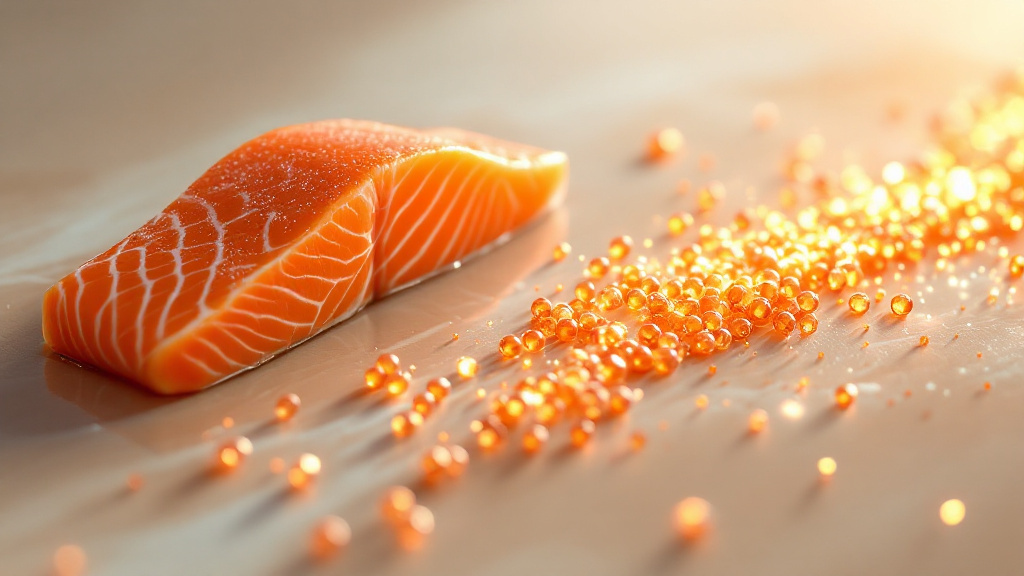
Food-grade salmon protein (often from the parts of the fish left after filleting) is treated with enzymes that cut it into peptides, then filtered and purified. The result is a defined protein hydrolysate — a consistent mix of small peptides. Researchers have specifically studied Atlantic salmon (Salmo salar) co-product hydrolysates as a source of bioactive, "antidiabetic-type" peptides.3
What the research actually shows
Here's the honest state of the science — real, but early. In laboratory (cell-based, in vitro) work:
- GLP-1 & GIP receptor activity — a soluble protein hydrolysate from Atlantic salmon dose-dependently increased activity at the body's GLP-1 and GIP (incretin) receptors, and the smallest peptide fraction was the most active.1
- Glucose handling & islet cells — the same line of work reported effects on glucose uptake and support for pancreatic islet cells in culture.12
- Broad food-protein context — this fits a larger body of research on how food proteins and hydrolysates influence the body's own GLP-1.4 Fish protein hydrolysates specifically have increased GLP-1 secretion in gut-cell studies.5
Important: these are laboratory findings, not proof of an effect in your body. They show why the ingredient is interesting and worth studying — not that it works like a medication.
The DPP-IV angle
One mechanism worth knowing: salmon peptides have been shown in vitro to inhibit DPP-IV, the enzyme that normally breaks GLP-1 down.2 Slowing that breakdown is one of the ways the body — and, separately, some medications — can extend GLP-1's natural signal. In salmon hydrolysate it's an early, laboratory-stage finding, but it's a real, specific mechanism researchers are examining.
Where triGLP fits
This is our lane, stated plainly. triGLP is a dietary supplement built on exactly this ingredient family — bioactive salmon peptides. The laboratory research above is why the ingredient is studied and why we use it. But we're careful about the claim: this science is early and mostly in cell models, so triGLP is made to support the natural GLP-1 signaling your body already runs — not to replicate a drug or treat a condition.
Bioactive salmon peptides, honestly
triGLP is salmon protein hydrolysate in four clean, sublingual ingredients — a dietary supplement made to help support the natural GLP-1 signaling your body already uses.
See the triGLP drops// ships from the official ORYGN storefront · dietary supplement · not a drug · results vary
The honest limits
The salmon-peptide research is genuinely encouraging, but it's early: most of it is in vitro (cells in a dish) or animal work, not large human trials, and a result in the lab is not a promise for any one person. Laboratory receptor activity is not the same as a clinical effect, and this page is educational, not medical advice. Salmon peptides are a dietary supplement, not a medicine — they don't treat, cure, or prevent any disease, and they don't replicate prescription GLP-1 drugs. Individual results vary. We link the studies so you can judge the evidence yourself.
Common questions
What is salmon protein hydrolysate in plain terms?
It's Atlantic salmon protein that's been broken down by enzymes into small, readily-absorbed peptides — essentially pre-digested salmon protein. Some of those peptides are "bioactive," meaning they do something in the body beyond basic nutrition. It's the ingredient family behind triGLP. Results vary by person.
Does salmon protein hydrolysate affect GLP-1?
In laboratory studies, yes — a soluble protein hydrolysate from Atlantic salmon increased activity at the body's GLP-1 and GIP receptors, and salmon peptides have inhibited the DPP-IV enzyme that breaks GLP-1 down. These are early, in-vitro findings that show why the ingredient is studied — not proof of an effect in humans. Results vary.
Is it the same as a GLP-1 drug like semaglutide?
No. Semaglutide is a prescription GLP-1 medication with strong human clinical-trial evidence. Salmon protein hydrolysate is a food-derived dietary supplement ingredient, studied mostly in cell models for supporting the body's own GLP-1 signaling. They are different categories, and the supplement does not replicate the drug's effects. Results vary.
Why hydrolyze the salmon protein at all?
Two reasons: the small peptide fragments are easier to absorb than whole protein, and hydrolysis unlocks specific bioactive peptides that whole protein keeps locked up. It's essentially doing ahead of time what digestion does — which is also why the active fragments can be studied and standardized. Results vary.
References
- Initial Exploration of the In Vitro Activation of GLP-1 and GIP Receptors and Pancreatic Islet Cell Protection by Salmon-Derived Bioactive Peptides. 2024. ncbi.nlm.nih.gov/pmc/articles/PMC11595994
- Glucoregulatory Properties of a Protein Hydrolysate from Atlantic Salmon (Salmo salar): Preliminary Characterization and Evaluation of DPP-IV Inhibition and Direct Glucose Uptake In Vitro. Marine Drugs, 2024. pmc.ncbi.nlm.nih.gov/articles/PMC11050766
- Atlantic salmon (Salmo salar) co-product-derived protein hydrolysates: A source of antidiabetic peptides. 2018. pubmed.ncbi.nlm.nih.gov/29579965
- Glucagon-like peptide-1 regulation by food proteins and protein hydrolysates. Review, 2021. pubmed.ncbi.nlm.nih.gov/33461642
- Blue Whiting Protein Hydrolysates Increase GLP-1 Secretion and Proglucagon Production in STC-1 Cells. Nutrients, 2022. ncbi.nlm.nih.gov/pmc/articles/PMC8877066
- Proteins and Peptides from Food Sources with Effect on Satiety and Their Role as Anti-Obesity Agents: A Narrative Review. Nutrients, 2024. ncbi.nlm.nih.gov/pmc/articles/PMC11510221