What are GLP-1 drops?
GLP-1 drops are a liquid you place under your tongue — a sublingual dietary supplement made to help support the GLP-1 signaling your body already produces. They are not injectable weight-loss drugs and not a prescription. Here's what they actually are, why the under-the-tongue route, what's in them, and what the research honestly shows — with sources.
"GLP-1 drops" (also searched as liquid GLP-1 or sublingual GLP-1) are a dietary supplement in liquid form, taken as drops under the tongue, formulated with bioactive food peptides — in our case, salmon protein hydrolysate — that are studied for supporting the body's own GLP-1 pathway.1 The under-the-tongue route is chosen because the tissue there is thin and richly supplied with blood, which for some compounds allows absorption directly into circulation.7 They are a supplement, not a GLP-1 medication like semaglutide, and they don't replicate one. Results vary.
On this page
What "GLP-1 drops" means
GLP-1 is a hormone your gut already makes after you eat — it's part of how your body signals fullness and manages blood sugar. "GLP-1 drops" are a liquid dietary supplement designed to support that natural signaling, delivered as drops you hold under your tongue rather than a pill you swallow or a shot you inject. The category is sometimes labeled liquid GLP-1 or sublingual GLP-1. Crucially, this is a supplement — it is not the hormone itself and not a prescription GLP-1 drug.4
"GLP-1 drops don't add a drug to your body — they're food-derived peptides meant to support a signal your body already runs."
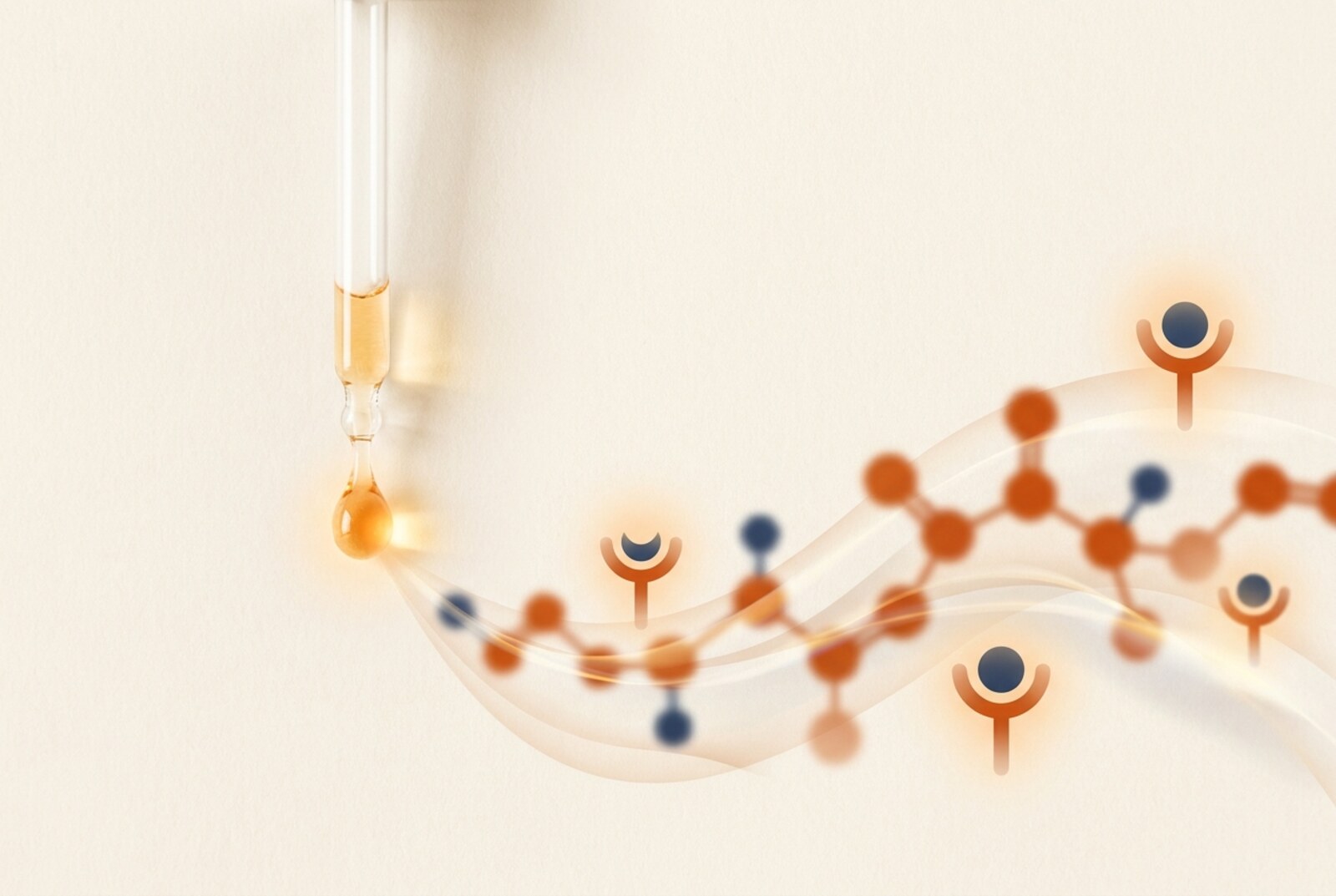
Why under the tongue?
The floor of the mouth is thin and densely supplied with blood vessels. For certain compounds, placing them there — the sublingual route — can allow absorption directly into the bloodstream, partly bypassing the digestive tract and the liver's "first-pass" processing that breaks many things down.7 That's the rationale behind delivering support ingredients as drops instead of a swallowed capsule.
Here's the honest part, because it matters: the mouth is not a magic gateway. Peptides are fragile, and the oral lining contains enzymes (peptidases) that can break them down before they're absorbed, which is exactly why sublingual peptide delivery is an active area of pharmaceutical research rather than a solved problem.8 So "under the tongue" is a considered delivery choice with a real rationale — not a guarantee of how much of any ingredient reaches your blood. Absorption is compound-specific, and results vary.
What's actually in them
Formulas differ by brand, but a GLP-1 support drop is built around an ingredient thought to interact with the GLP-1 pathway. In our case that's salmon protein hydrolysate — whole Atlantic salmon protein broken by enzymes into small bioactive peptides.1 We cover the ingredient itself in depth here: what salmon protein hydrolysate is. The point of a drop format is to deliver those peptides sublingually rather than as a swallowed powder.
What the research actually shows
Two separate questions matter, and it's honest to keep them apart: (1) does the ingredient engage the GLP-1 pathway, and (2) does the drop delivery get it there. Here's where each stands.
- The ingredient — early but real. In laboratory (cell) studies, a soluble salmon protein hydrolysate activated the body's GLP-1 and GIP receptors, with the smallest peptide fraction most active,1 and salmon peptides have inhibited DPP-IV, the enzyme that breaks GLP-1 down.2 This fits a broader body of work on how food proteins and their hydrolysates influence the body's own GLP-1.35
- The delivery — a rationale, not a proven dose. Sublingual delivery can, for some molecules, improve absorption over swallowing,7 but peptide absorption across the oral lining faces real barriers.8 No study here proves a specific amount of salmon peptide reaches your blood from a drop.
Put plainly: the ingredient shows genuine, specific laboratory activity on the GLP-1 pathway, and sublingual delivery has a legitimate absorption rationale — but neither is a promise of a clinical effect in your body. These are early findings that show why the approach is studied, not proof that it works like a medication.
GLP-1 drops vs. GLP-1 injections
This is the distinction that clears up most of the confusion. GLP-1 injections — semaglutide (Ozempic, Wegovy) and similar — are prescription medications with large human clinical-trial evidence; they deliver an engineered drug that acts strongly on GLP-1 receptors. GLP-1 drops are a food-derived dietary supplement intended to support the GLP-1 signaling your body already makes. They are different categories with different evidence, and drops do not replicate, replace, or equal the drugs. Anyone marketing "drops" as a needle-free Ozempic is reaching well past the science.
Salmon-peptide GLP-1 drops, honestly
triGLP is salmon protein hydrolysate delivered as clean drops under the tongue — a dietary supplement made to help support the natural GLP-1 signaling your body already uses.
See the triGLP drops// ships from the official ORYGN storefront · dietary supplement · not a drug · results vary
Where triGLP fits
Stated plainly: triGLP is a GLP-1 support drop. It's salmon protein hydrolysate formulated to be taken sublingually — the drops this page describes. Because the human evidence for the ingredient is early and the sublingual absorption of peptides is genuinely hard, we make a careful claim: triGLP is designed to support the natural GLP-1 signaling your body already runs, not to act like a drug or treat any condition. That honesty is the whole point — it's how you tell a real explanation from a sales pitch dressed up as one.
The honest limits
The salmon-peptide GLP-1 research is genuinely encouraging but early — mostly in vitro (cells in a dish), not large human trials — and a lab result is not a promise for any one person. Sublingual delivery has a real absorption rationale, but it does not guarantee how much of any peptide reaches your blood; peptide sublingual delivery is still an active research problem. GLP-1 drops are a dietary supplement, not a medicine — they don't treat, cure, or prevent any disease, and they don't replicate prescription GLP-1 drugs. This page is educational, not medical advice. Individual results vary. We link the studies so you can weigh the evidence yourself.
Common questions
What are GLP-1 drops in plain terms?
They're a liquid dietary supplement you place under your tongue, formulated with bioactive food peptides (in our case salmon protein hydrolysate) meant to support the body's own GLP-1 signaling. They're a supplement, not a hormone and not a prescription drug. Results vary.
Do sublingual GLP-1 drops actually work?
The ingredient shows real laboratory activity on the GLP-1 pathway, and the under-the-tongue route has a legitimate absorption rationale — but no study proves a specific clinical effect from the drops in people, and peptide absorption across the mouth lining is genuinely difficult. So they're studied and reasoned, not proven to work like a medication. Results vary.
Are GLP-1 drops the same as Ozempic or semaglutide?
No. Semaglutide (Ozempic, Wegovy) is a prescription GLP-1 medication with large human clinical-trial evidence. GLP-1 drops are a food-derived dietary supplement meant to support your body's own GLP-1 signaling. Different categories, different evidence — the drops do not replicate or replace the drug. Results vary.
Why under the tongue instead of a pill?
The tissue under the tongue is thin and rich in blood vessels, so for some compounds it can allow absorption directly into the bloodstream, partly bypassing digestion and the liver's first-pass breakdown. It's a considered delivery choice with a real rationale — though the mouth also contains enzymes that can degrade peptides, so it's not a guarantee. Results vary.
Who should avoid GLP-1 drops?
Anyone with a fish or shellfish allergy should avoid salmon-derived drops without medical guidance. Data are limited in pregnancy and breastfeeding, so check with a clinician first. And if you take prescription medication or manage a health condition, talk to your doctor before adding any supplement. Results vary.
References
- Initial Exploration of the In Vitro Activation of GLP-1 and GIP Receptors and Pancreatic Islet Cell Protection by Salmon-Derived Bioactive Peptides. Marine Drugs, 2024;22(11):490. pmc.ncbi.nlm.nih.gov/articles/PMC11595994
- Glucoregulatory Properties of a Protein Hydrolysate from Atlantic Salmon (Salmo salar): DPP-IV Inhibition and Direct Glucose Uptake In Vitro. Marine Drugs, 2024. pmc.ncbi.nlm.nih.gov/articles/PMC11050766
- Glucagon-like peptide-1 regulation by food proteins and protein hydrolysates. Review, 2021. pubmed.ncbi.nlm.nih.gov/33461642
- Glucagon-like peptide-1 (GLP-1) physiology — overview. StatPearls / NCBI Bookshelf. ncbi.nlm.nih.gov/books/NBK551686
- Blue Whiting Protein Hydrolysates Increase GLP-1 Secretion and Proglucagon Production in STC-1 Cells. Nutrients, 2022. ncbi.nlm.nih.gov/pmc/articles/PMC8877066
- Proteins and Peptides from Food Sources with Effect on Satiety and Their Role as Anti-Obesity Agents: A Narrative Review. Nutrients, 2024. ncbi.nlm.nih.gov/pmc/articles/PMC11510221
- Sublingual and Buccal Delivery: A Historical and Scientific Prescriptive. Review. pmc.ncbi.nlm.nih.gov/articles/PMC12389210
- Overcoming Oral Cavity Barriers for Peptide Delivery Using Advanced Pharmaceutical Techniques and Nano-Formulation Platforms. ncbi.nlm.nih.gov/pmc/articles/PMC12650023