GLP-1 and muscle loss
GLP-1 medications are remarkably effective at reducing weight — but that weight isn't only fat. A meaningful share of it can be muscle. Here's why rapid weight loss costs lean mass, what the research actually shows, and the evidence-based way to protect your muscle while you lose fat — honestly, with sources.
Any rapid weight loss — including on GLP-1 medications like semaglutide — tends to reduce both fat and lean (muscle) tissue. In several analyses, lean soft tissue made up roughly a quarter to 40% of the total weight lost.1 The good news: the muscle loss is largely modifiable. The best-supported way to protect it is adequate protein plus resistance (strength) training during weight loss.23 Supplements can be part of a protein-forward approach, but they don't replace the training. Results vary, and this is educational, not medical advice.
On this page
Why GLP-1 weight loss costs muscle
This isn't unique to GLP-1 drugs — it's how the body handles a big energy deficit. When you lose weight quickly, the body draws down both fat stores and lean tissue (muscle and organ mass), especially if protein intake drops and the muscles aren't being asked to work. GLP-1 medications produce fast, substantial weight loss and often reduce appetite so much that people simply eat less protein — which removes two of the main signals that tell the body to keep muscle.2
"The scale going down is only half the story. What you want to lose is fat — and keeping muscle is something you have real control over."
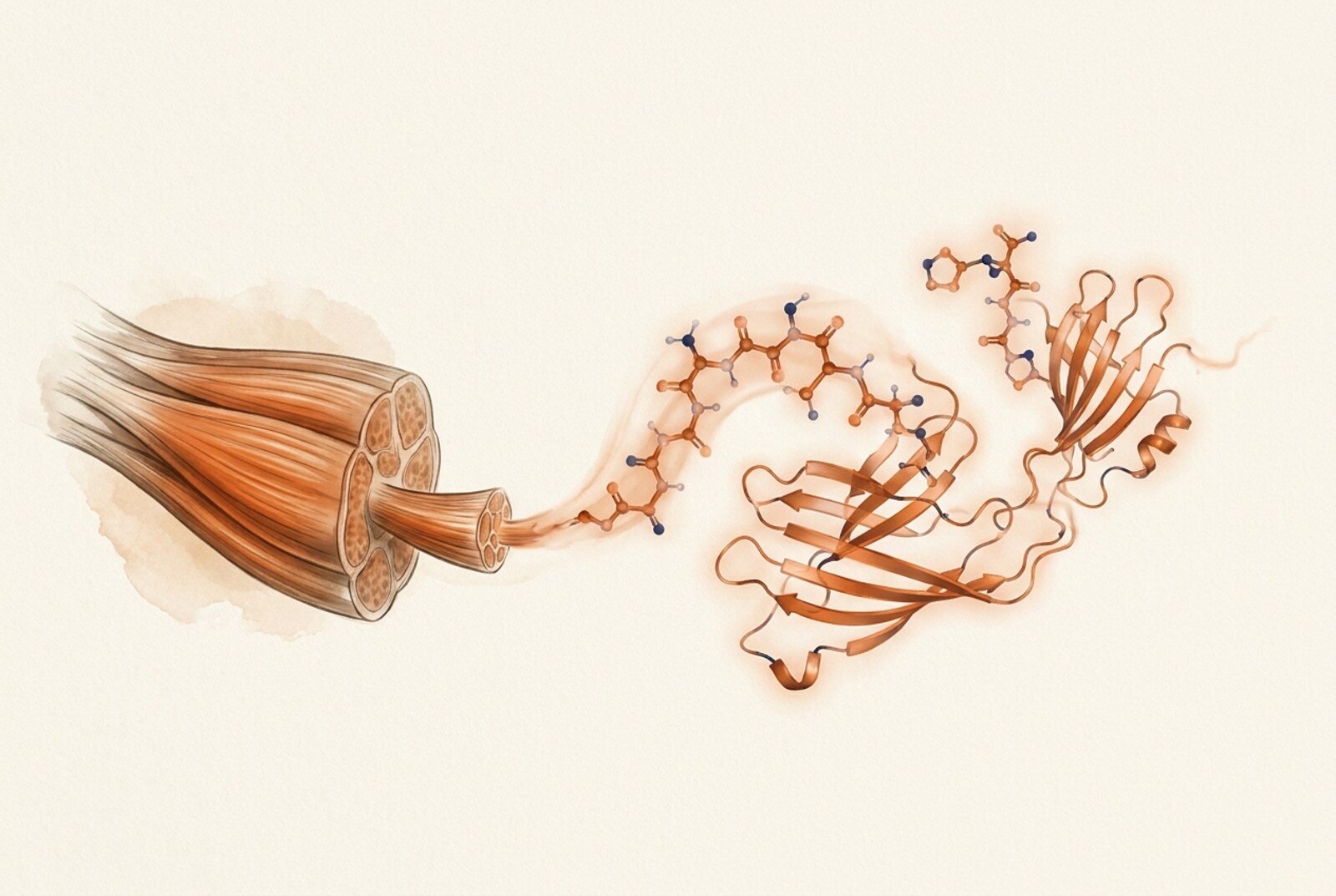
How much muscle, really?
Estimates vary by study and by how "lean mass" is measured, but reviews of recent GLP-1 and GLP-1/GIP trials report that lean soft tissue accounted for roughly 26–40% of the weight lost.1 It's worth an honest caveat in the other direction, too: some researchers argue the muscle loss is proportional to the amount of weight lost — not disproportionately high — and that a portion is expected any time a body gets smaller.4 Both things can be true: real muscle is lost, and how much of your function you keep depends heavily on what you do about it.
Why lean mass matters
Muscle isn't just about looking toned. It's central to strength, mobility, and metabolic rate — and losing too much can leave you weaker and can make weight regain easier later, because a smaller muscle mass burns fewer calories at rest. Protecting muscle is one of the biggest levers for making weight loss feel good and hold up over time.1
The muscle-protection playbook (what the evidence supports)
The most defensible approach in the current literature is a "food-first" plan built on two pillars, with supplements as helpers rather than the main event:1
- Enough protein. Case-series patients who preserved lean tissue typically ate around 1.6–2.3 g of protein per kg of fat-free mass (often ~0.7–1.7 g/kg of body weight) — deliberately protein-forward, which is harder when appetite is suppressed.3
- Resistance (strength) training. Lifting or bodyweight resistance work, several days a week, is the single strongest signal telling your body to hold onto muscle. The LEAN-PREP randomized trial is specifically testing resistance exercise and protein during semaglutide/tirzepatide therapy for exactly this reason.25
- Supplements are adjunctive. Reviews place protein/complete-nutrition support first, with things like creatine, leucine/EAAs, and others as secondary options supported mainly by indirect evidence.1
Above all: if you're on a GLP-1 program, this is a conversation to have with your prescriber or a dietitian — muscle protection is part of good care, not an afterthought.
Where protein & peptides fit
Since protein is the nutritional cornerstone of keeping muscle, getting enough of it — especially when a medication is blunting your appetite — is the practical challenge. That's why high-quality protein sources, including protein hydrolysates and peptides, are useful tools for hitting a protein target without a huge volume of food. They are a way to support a protein-forward diet, not a replacement for training and not a treatment for any medication's side effects.
A protein-forward peptide, honestly
triGLP is salmon protein hydrolysate — bioactive salmon peptides taken as clean sublingual drops. A dietary supplement that fits a protein-forward, muscle-minded approach; it doesn't replace protein meals or strength training.
See the triGLP drops// ships from the official ORYGN storefront · dietary supplement · not a drug · results vary
Where salmon peptides fit
Salmon peptides are food-derived protein fragments — the salmon protein hydrolysate family. In the one published human pilot of the ProGo ingredient, participants lost fat while their lean mass was preserved (lean body mass percentage rose modestly as fat fell).6 That's a small, early pilot — and importantly, it was a standalone supplement study, not a study of people on GLP-1 drugs — so it is not evidence that salmon peptides prevent medication-related muscle loss. What it does show is that a salmon-peptide, protein-forward approach is consistent with a "keep the muscle, lose the fat" goal. If you want the ingredient's fuller story, see what salmon protein hydrolysate is.
The honest limits
Muscle loss during rapid weight loss is real, but the numbers vary by study and measurement method, and some of it is a normal consequence of getting smaller. No supplement — salmon peptides included — treats, prevents, or reverses medication-related muscle loss; the evidence-based levers are protein and resistance training, ideally guided by your clinician. The ProGo lean-mass finding is a small pilot (n=14) in people not on GLP-1 drugs, so don't read it as proof for that situation. Salmon peptides are a dietary supplement, not a medicine, and don't diagnose, treat, cure, or prevent any disease. This page is educational, not medical advice. Individual results vary. We link the studies so you can weigh them yourself.
Common questions
Does GLP-1 (like Ozempic) cause muscle loss?
GLP-1 medications cause fast weight loss, and rapid weight loss of any kind reduces both fat and lean (muscle) tissue — reviews report lean soft tissue was roughly 26–40% of the weight lost in recent trials. It's largely modifiable with protein and strength training. This is educational, not medical advice; talk to your prescriber. Results vary.
How do I keep muscle while losing weight on a GLP-1?
The best-supported approach is a food-first plan: enough protein (case-series patients preserving muscle ate roughly 1.6–2.3 g per kg of fat-free mass) plus regular resistance/strength training. Supplements are secondary helpers. Coordinate with your prescriber or a dietitian. Results vary.
Will salmon peptides prevent muscle loss from GLP-1 drugs?
No — no supplement is shown to prevent medication-related muscle loss, and salmon peptides are not studied in people on GLP-1 drugs. They're a food-derived protein source that can support a protein-forward diet, which is one part of the muscle-protection picture alongside resistance training. Results vary.
Is the muscle loss permanent?
Not necessarily. Muscle responds to how it's used and fed — resistance training and adequate protein can help rebuild and maintain it. The key is to protect it during the weight-loss phase rather than trying to recover it all afterward. Talk to a clinician about your plan. Results vary.
How much protein should I aim for?
In case-series patients who preserved lean tissue, protein intakes were commonly around 1.6–2.3 g per kg of fat-free mass (roughly 0.7–1.7 g/kg of body weight). Exact targets depend on you, so confirm with your clinician or dietitian — especially since GLP-1 medications can make eating that much protein harder. Results vary.
References
- Lean Mass and Musculoskeletal Preservation in GLP-1-Based Obesity Treatment: Nutrition, Exercise, Supplementation, and Monitoring Strategies. Metabolites, 2026;16(6):364. mdpi.com/2218-1989/16/6/364
- LEAN mass Preservation with Resistance Exercise and Protein during semaglutide and tirzepatide therapy (LEAN-PREP): protocol for a randomised controlled trial. pubmed.ncbi.nlm.nih.gov/42020128
- Preservation of lean soft tissue during weight loss induced by GLP-1 and GLP-1/GIP receptor agonists: A case series. pmc.ncbi.nlm.nih.gov/articles/PMC12536186
- Weight loss with GLP-1 medicines does not result in a disproportionate loss of muscle mass or function in obese mice and humans. pubmed.ncbi.nlm.nih.gov/41850248
- Function and Lean Mass Preservation With Resistance Exercise During a GLP-1RA Treatment. ClinicalTrials.gov NCT07457437. clinicaltrials.gov/study/NCT07457437
- A Pilot Study of Salmon Protein Hydrolysate (ProGo) Supplementation on Hematologic, Integumentary and Metabolic Health. Biomedicines, 2026;14(8):1663. mdpi.com/2227-9059/14/8/1663
- Proteins and Peptides from Food Sources with Effect on Satiety and Their Role as Anti-Obesity Agents: A Narrative Review. Nutrients, 2024. ncbi.nlm.nih.gov/pmc/articles/PMC11510221