What is food noise?
You just ate, and twenty minutes later your brain is already talking about the next thing. That running commentary has a name now — "food noise" — and it isn't a willpower problem. It's a signaling problem. Here's the science of why it happens and how to turn the volume down, honestly and with sources.
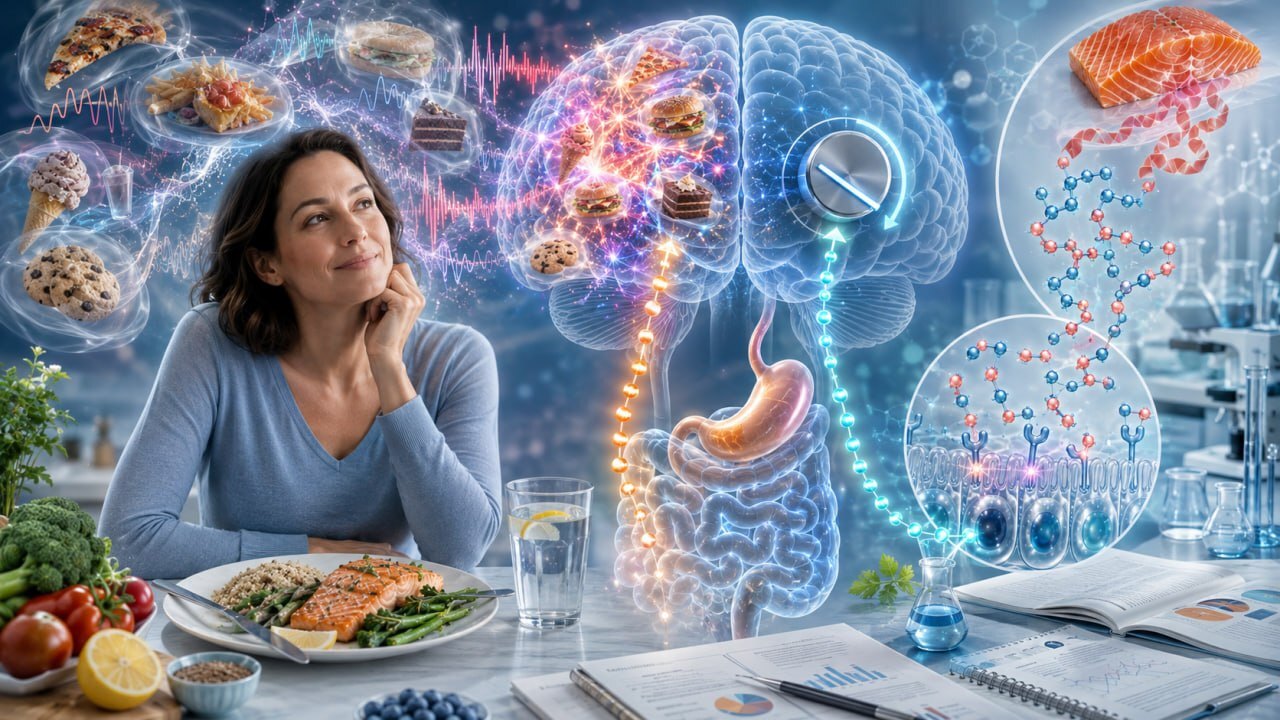
Food noise is the constant, intrusive mental chatter about food — thinking about it, craving it, and planning the next bite even when you're not truly hungry. It's driven largely by your appetite hormones, especially the balance between hunger signals like ghrelin and fullness signals like GLP-1. When the fullness signal is strong, the noise gets quieter.1
On this page
What food noise really is
"Food noise" is the everyday term — not a medical diagnosis — for the persistent stream of thoughts about eating: the craving that won't quit, the mental negotiation in front of the pantry, the sense that food is always somewhere in your head. Lots of people assumed for years that this was just weak willpower. It isn't. It's largely your biology talking.
The reason the phrase exploded is that people who changed their appetite signaling suddenly noticed the noise go quiet — and realized, often for the first time, how loud it had been.
"Food noise isn't a character flaw. It's a volume knob — and the knob is mostly your hormones."
Why it happens
Your appetite runs on a conversation between hormones. Two of the main voices:
- Ghrelin — the "hunger" hormone. It goes up before meals and pushes you toward food.
- GLP-1 — a "fullness" hormone your gut releases after you eat. It signals satisfaction and helps quiet the drive to keep eating.
When the fullness side of that conversation is weak or short-lived, the hunger side dominates — and that shows up in your head as food noise. Research on fish protein hydrolysates has specifically looked at both sides, including effects on the desire to eat something sweet.23
How GLP-1 turns the volume down
GLP-1 is one of the body's main "I'm satisfied" signals. It's part of why a genuinely filling meal quiets the chatter, and why a snack that spikes and crashes leaves the noise louder than before. Support your natural GLP-1 signal and you're supporting the very mechanism that dials food noise down.1
Turning the volume down — naturally
Because food noise is largely a signaling issue, the honest levers are the ones that strengthen your fullness signal:
- Protein first — protein is one of the strongest natural triggers of GLP-1 and satiety.
- Fiber — fermentable fiber feeds gut bacteria that prompt fullness hormones.
- Slower, whole meals — how you eat changes how strong the signal gets.
- Certain bioactive peptides — studied for supporting the same satiety signaling, below.
Where salmon peptides fit
This is the interesting part. In laboratory studies, fish protein hydrolysates increased the body's own GLP-1 secretion,4 and in a small human study a fish protein hydrolysate influenced appetite hormones including GLP-1 — along with a reduced desire for something sweet.2 Salmon-derived peptides specifically enhanced GLP-1 release in gut-cell models.5
That's the whole idea behind salmon-peptide drops for food noise: not to override your appetite, but to support the satiety signal that naturally quiets it.
Quiet the noise, naturally
triGLP is bioactive salmon peptides in four clean, sublingual ingredients — made to help support the fullness signals that turn food noise down, not to override your body.
See the triGLP drops// ships from the official ORYGN storefront · dietary supplement · not a drug · results vary
The honest limits
"Food noise" is a popular term, not a clinical diagnosis, and the research on food-derived salmon and fish peptides is still small and early — much of it in cell and animal models. Encouraging signals in a study are not a promise for any individual. Salmon peptides are a dietary supplement, not a medicine — they don't treat a disease, they won't override biology, and results vary. If food thoughts are severely disrupting your life, that's worth raising with a professional. We link the studies so you can judge for yourself.
Common questions
What is food noise, exactly?
It's the everyday name for constant, intrusive thoughts about food — cravings and mental chatter about eating even when you're not truly hungry. It's not a medical diagnosis; it's largely driven by your appetite hormones, especially the balance of hunger (ghrelin) and fullness (GLP-1) signals.
Is food noise a real thing or just willpower?
It's real biology, not weak willpower. The intensity of food thoughts is heavily influenced by appetite-signaling hormones. When your fullness signal is strong, the noise tends to quiet; when it's weak, hunger signals dominate.
How do you stop food noise naturally?
By strengthening your natural fullness signal: prioritizing protein, eating fermentable fiber, slowing meals down, and — an area of active research — certain bioactive peptides studied for supporting GLP-1 and satiety. None of this is a guarantee, and results vary.
Does GLP-1 reduce food noise?
GLP-1 is one of the body's main fullness signals, and supporting it supports the mechanism that naturally quiets appetite chatter. Fish and salmon peptides have been studied for stimulating the body's own GLP-1 release. It's support of a normal function, not a cure, and results vary.
References
- Bioactivities, Applications, Safety, and Health Benefits of Bioactive Peptides From Food and By-Products: A Review. Frontiers in Nutrition, 2021. frontiersin.org/articles/10.3389/fnut.2021.815640
- Supplementation with a fish protein hydrolysate (Micromesistius poutassou): effects on body weight, body composition, and CCK/GLP-1 secretion. Food & Nutrition Research, 2016;60:29857. ncbi.nlm.nih.gov/pmc/articles/PMC4734037
- Acute effect of a cod protein hydrolysate on postprandial acylated ghrelin concentration and sensations associated with appetite in healthy subjects. Food & Nutrition Research, 2019. ncbi.nlm.nih.gov/pmc/articles/PMC6814894
- Blue Whiting Protein Hydrolysates Increase GLP-1 Secretion and Proglucagon Production in STC-1 Cells. Nutrients, 2022. ncbi.nlm.nih.gov/pmc/articles/PMC8877066
- Atlantic salmon (Salmo salar) co-product-derived protein hydrolysates: A source of antidiabetic peptides. Food Research International, 2018. sciencedirect.com/science/article/abs/pii/S0963996918300255