Bioactive peptides for weight loss: what the research actually shows.
"Weight loss peptides" is one of the most searched — and most oversold — terms in health right now. So let's do the honest version: what bioactive salmon and fish peptides have actually been shown to do for appetite and satiety, what they haven't, and where the hype ends. Cited, no promises.
"Weight loss peptides" covers two very different things. Some are injectable prescription drugs. Others are food-derived bioactive peptides — like salmon peptides — studied as dietary supplements for supporting satiety and appetite signaling. The food-derived kind isn't a weight-loss drug and won't act like one; the research points to gentle support of your body's own fullness signals, and it's still early. Results vary.1
On this page
"Weight loss peptides" — two very different things
The phrase gets used for two categories that could not be more different, and conflating them is where people get misled:
- Injectable prescription peptides — pharmaceutical drugs, prescribed and monitored by a doctor for specific medical conditions. Powerful, and not what we're talking about here.
- Food-derived bioactive peptides — short protein fragments from foods like salmon, studied as dietary supplements for supporting normal appetite and satiety. This is our lane.
A food-derived salmon peptide is not a weaker version of an injection. It works by a different idea entirely: gently supporting the appetite signals your body already produces, rather than delivering a drug.
"The honest promise isn't 'melts fat.' It's 'helps support the fullness signals your body already makes.' Those are not the same sentence."
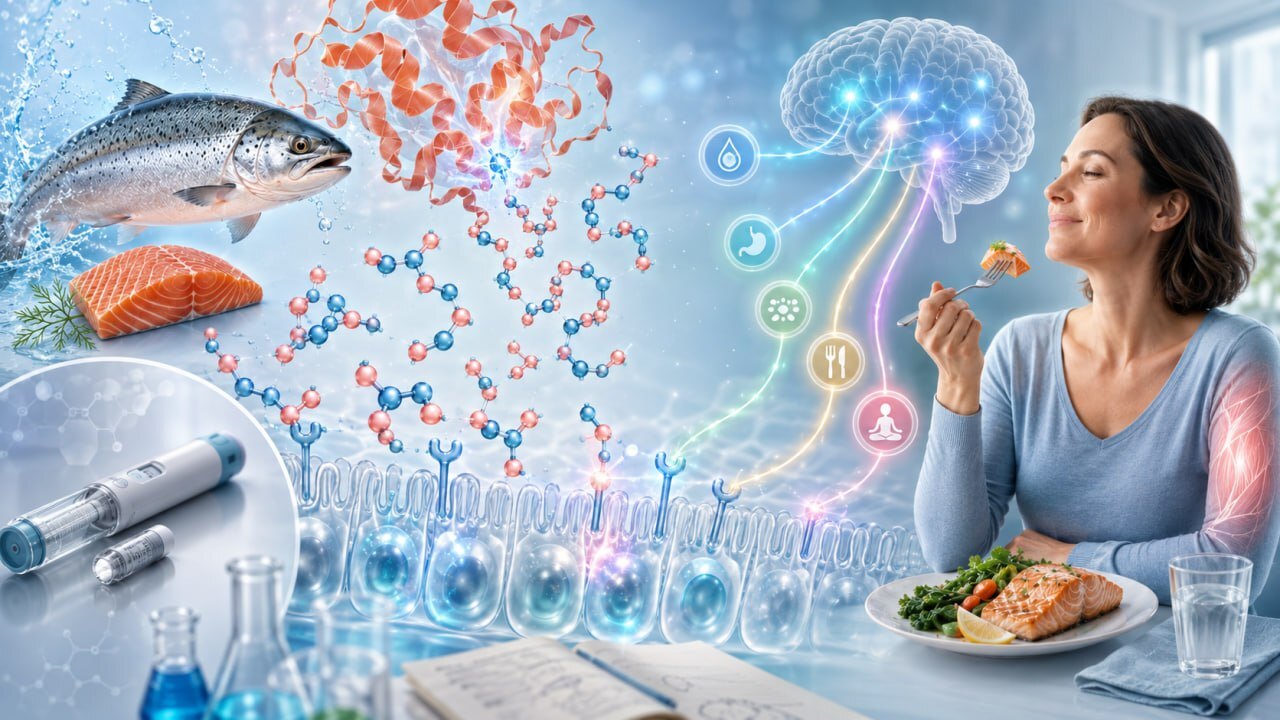
What the research actually shows
For food-derived fish and salmon peptides, the studied effect centers on satiety and appetite signaling — the feeling of fullness that helps you naturally eat less without forcing it. In laboratory studies, fish protein hydrolysates increased the body's own release of GLP-1, a hormone tied to fullness.2 In a small human study, a fish protein hydrolysate influenced appetite hormones (CCK and GLP-1) alongside changes in body weight and composition, and affected the desire to eat something sweet.3 A separate human trial found a fish protein hydrolysate affected the hunger hormone ghrelin after eating.4
Read that carefully: the mechanism under study is helping promote satiety and support healthy appetite regulation — not "burning fat." Eating a little less because you feel satisfied is the honest route these peptides are researched for.
The muscle question
One real concern with rapid weight loss of any kind is losing muscle along with fat. Because salmon peptides are, at their core, a high-quality protein source, they're studied in the context of supporting lean muscle preservation during weight management.1 That's a meaningful difference from approaches that drop weight without regard to what kind of weight is lost.
Salmon peptides specifically
Salmon isn't a random choice. Researchers working with Atlantic salmon (Salmo salar) protein hydrolysates identified peptide fractions that enhanced GLP-1 release in gut-cell models, describing them as a potential source of metabolically active peptides.5 The suggested effective doses in the human fish-hydrolysate literature land around 1–6 grams per day.3 That's the science behind putting salmon peptides into a daily sublingual drop.
The honest version, in a drop
triGLP is bioactive salmon peptides in four clean, sublingual ingredients — made to help support satiety and the appetite signals your body already has. Not a drug. Not a miracle. Just the honest lane.
See the triGLP drops// ships from the official ORYGN storefront · dietary supplement · not a drug · results vary
What the research does NOT show
We're not going to oversell this, because overselling it would be a lie. The human research on food-derived fish peptides is small and preliminary, and much of the mechanism work is in cell and animal models. These peptides are a dietary supplement — not a weight-loss drug, not a treatment for obesity or any disease, and no guarantee of any specific result. They don't "target fat," they don't work without the rest of your habits, and outcomes vary from person to person. What they honestly offer is support for your body's own satiety signals. Anyone with a health condition should decide based on their own situation. The studies are linked below — read them yourself.
Common questions
Do peptides actually work for weight loss?
It depends entirely which peptides. Injectable prescription peptides are drugs with strong effects and medical supervision. Food-derived bioactive peptides like salmon peptides are dietary supplements studied for supporting satiety and appetite signaling — a gentler, indirect route, and the human research is still preliminary. They support the process; they don't force it. Results vary.
What are weight loss peptides?
It's a loose umbrella term. It can mean prescription injectable drugs, or it can mean food-derived bioactive peptides (from salmon, fish, and other proteins) sold as dietary supplements and studied for satiety and appetite support. The two are completely different in strength, regulation, and how they work.
Are natural peptides for weight loss safe?
Food-derived peptides come from ordinary dietary proteins and are consumed as foods and supplements. This is educational information, not medical advice — if you're pregnant, nursing, on medication, or managing a condition, decide based on your own circumstances.
How are salmon peptides different from a weight-loss shot?
A shot delivers a synthetic drug that imitates a hormone at pharmaceutical strength. Salmon peptides are a food-derived supplement studied for supporting your body's own satiety signals. Different category, different strength, different idea — not a substitute for medical care.
References
- A Review on Health-Promoting, Biological, and Functional Aspects of Bioactive Peptides in Food Applications. Biomolecules, 2021;11(5):631. ncbi.nlm.nih.gov/pmc/articles/PMC8145060
- Blue Whiting Protein Hydrolysates Increase GLP-1 Secretion and Proglucagon Production in STC-1 Cells. Nutrients, 2022. ncbi.nlm.nih.gov/pmc/articles/PMC8877066
- Supplementation with a fish protein hydrolysate (Micromesistius poutassou): effects on body weight, body composition, and CCK/GLP-1 secretion. Food & Nutrition Research, 2016;60:29857. ncbi.nlm.nih.gov/pmc/articles/PMC4734037
- Acute effect of a cod protein hydrolysate on postprandial acylated ghrelin concentration and sensations associated with appetite in healthy subjects. Food & Nutrition Research, 2019. ncbi.nlm.nih.gov/pmc/articles/PMC6814894
- Atlantic salmon (Salmo salar) co-product-derived protein hydrolysates: A source of antidiabetic peptides. Food Research International, 2018. sciencedirect.com/science/article/abs/pii/S0963996918300255