Natural appetite suppressant — what actually works
Here's the honest reframe up front: a "natural appetite suppressant" isn't a pill that switches hunger off. It's the set of foods, signals and habits that help your body turn its own appetite down — protein, fiber, water, sleep, and the fullness hormones they trigger. This is a buyer's-and-eater's guide: what the published research actually supports, the red flags in over-the-counter "suppressant" pills, and where salmon peptides honestly fit — with sources.
The most reliable "natural appetite suppressants" aren't supplements at all — they're protein, fermentable fiber, water, and sleep, because those are the levers that raise your body's own fullness signals (GLP-1, PYY, CCK) and calm hunger.136 High-protein eating is the single best-supported dietary lever for satiety;3 fiber, a pre-meal glass of water, and adequate sleep each help too.689 OTC "appetite suppressant" pills are a different story — most haven't been shown to work, aren't tested the way drugs are, and some hide illegal ingredients.10 Judge any product on evidence, honesty, and realistic expectations. Not a drug. Results vary.
On this page
What a "natural appetite suppressant" really means
Search the phrase and you'll find pills promising to "crush cravings." Start with the honest distinction instead. A pharmaceutical appetite suppressant — an anorectic — is a drug that reduces appetite. "Natural" appetite support is a different category entirely: it's the food and lifestyle inputs that help your body raise its own satiety signals so you feel full sooner and stay full longer. No food or supplement replicates a prescription drug, and the research on natural appetite support is candid that the effects are indirect and modest.1 So the useful question isn't "what kills hunger?" — it's "what genuinely nudges my fullness signals, and what's just hype?"
"The best natural appetite suppressant isn't something you buy — it's a plate built to make your own body say 'enough' sooner."
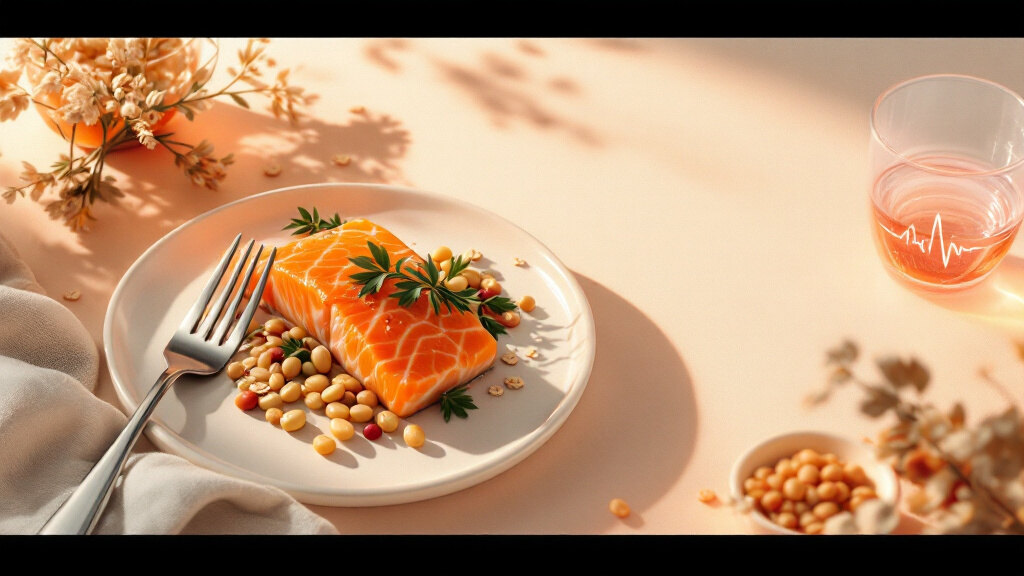
How your body turns appetite down
Appetite isn't willpower — it's chemistry. After you eat, your gut releases fullness hormones that travel to your brain and tell it to ease off: GLP-1, PYY and CCK all rise in response to food, and GLP-1 in particular acts on the brain's appetite centers to reduce how much you eat.2 On the other side sit the hunger drivers — chiefly ghrelin, which climbs before meals and when you're short on sleep.9 A "natural appetite suppressant," properly understood, is anything that tips this balance toward the fullness side. The levers below are the ones with real evidence behind them.
1. Protein — the most filling lever
If you do one thing, do this. Higher dietary protein increases satiety and supports weight management, partly by raising the appetite-regulating gut hormones GLP-1 and PYY — a well-reviewed effect in human research.3 Protein produces the biggest fullness response of the three macronutrients, and specific protein fragments (peptides) can act directly on the gut cells that release those hormones.45 The practical version: anchor each meal with a real protein source, because it does more to quiet the next few hours of hunger than almost anything on a supplement shelf. Do this: aim to start meals with protein, and treat it as your first-line "suppressant."
2. Fermentable fiber
Fiber is the slow, steady lever. Fermentable and soluble fibers (β-glucan from oats and barley, psyllium, inulin) feed gut bacteria that make short-chain fatty acids, and those signal the GLP-1-producing cells.7 In one controlled human study, delivering a fiber-fermentation product (propionate) to the colon raised GLP-1 and PYY, reduced how much people ate at a meal, and curbed weight gain over 24 weeks.6 The honest caveat: this is a build-over-weeks effect from consistent daily fiber, not an instant hunger switch. Do this: build meals around fiber-rich whole foods and expect the benefit to compound, not spike.
3. Water, volume & eating pace
The simplest lever is nearly free. In a randomized trial in middle-aged and older adults on a reduced-calorie diet, drinking about 500 mL of water before each main meal led to roughly 2 kg more weight loss over 12 weeks than dieting alone, and pre-meal water lowered how many calories people ate at that meal.8 High-volume, water-rich foods (soups, vegetables, fruit) work on the same principle — they fill the stomach for fewer calories. Do this: a glass of water before meals and slowing your eating pace give your fullness signals time to catch up before you overshoot.
Where salmon peptides fit
triGLP is a dietary supplement built on bioactive salmon peptides — the marine, food-derived protein fragments studied for supporting the body's own GLP-1 and satiety signaling, and IGNYT is a dissolvable sachet. Think of them as a supportive tool alongside the protein-fiber-water-sleep basics on this page — not a drug, not a stand-alone "suppressant," and never a replacement for any medication. Named ingredients, no proprietary-blend games.
See the triGLP drops// ships from the official ORYGN storefront · dietary supplement · not a drug · results vary
4. Sleep & stress
This is the lever most "appetite suppressant" pages ignore. Short sleep shifts your hunger chemistry the wrong way: in a population study, people sleeping less than 8 hours had lower leptin (the "I've had enough" hormone) and higher ghrelin (the "feed me" hormone) — a combination the authors note is "likely to increase appetite."9 In other words, a poor night can quietly turn your appetite up the next day, no matter what you eat. Stress and its cortisol response push in a similar direction for many people. Do this: protect your sleep and manage stress; it may be the most underrated natural appetite lever you have.
The OTC "suppressant pill" problem
Now the red flags. The over-the-counter "appetite suppressant" aisle is where honesty goes to die, so hold anything there up to reality first:
- Most haven't been shown to work. The U.S. National Center for Complementary and Integrative Health is blunt: many supplements marketed for weight loss "have not been tested for safety," and common ones haven't been shown to produce meaningful weight loss in studies.10
- Supplements aren't tested like drugs. A product can be sold and heavily marketed without proving it works, because the FDA doesn't review supplement efficacy the way it reviews medications.10
- Some hide illegal ingredients. The FDA has repeatedly found weight-loss products sold as "supplements" that secretly contain prescription drugs or other illegal ingredients — a real safety hazard.10
- "Natural Ozempic," guaranteed results, disease claims. Any of these is a walk-away signal — no supplement replicates a prescription drug, and drug-like promises are a sign the seller doesn't respect the rules or you.
- "Proprietary blend," no doses. If they won't tell you how much of what is inside, you can't judge whether it's a real dose or fairy dust.
None of this means every supplement is worthless. It means the format never substitutes for the basics — and the honest ones name their ingredients, disclose doses, and make modest, structure/function claims rather than promising to switch off hunger.
The honest limits
Natural appetite support is a nudge, not medicine. The effects of protein, fiber, water and sleep on your fullness signals are real but modest, build with consistency, and vary from person to person — and marine-peptide effects in particular are dose-dependent and not universal, with some human studies showing no acute change.12 No food or supplement replicates a prescription appetite or weight-loss drug, and nothing here diagnoses, treats, cures, or prevents any disease. This page is educational, not medical advice — talk to your clinician, especially if you take medications. We link the studies so you can weigh the evidence yourself. Results vary.
Common questions
What is the best natural appetite suppressant?
The best-supported ones aren't pills — they're protein at every meal, daily fermentable fiber, a glass of water before meals, and adequate sleep. Each raises your body's own fullness signals (GLP-1, PYY, CCK) or lowers hunger hormones like ghrelin. Supplements can play a supporting role, but they work alongside these basics, not instead of them, and no natural option replaces a prescription drug. Results vary.
Do natural appetite suppressant supplements actually work?
Some ingredients genuinely nudge appetite — protein and food-derived peptides, fermentable fiber, and a few others have research behind them — but the effects are modest, indirect and build over time. Many over-the-counter "appetite suppressant" pills, on the other hand, haven't been shown to work, aren't tested for safety the way drugs are, and some have been found to hide illegal ingredients. Judge on evidence, honest labeling, and realistic expectations. Results vary.
What foods naturally suppress appetite?
Protein-rich foods (fish, eggs, Greek yogurt, legumes) are the most filling; fermentable-fiber foods (oats, barley, beans, psyllium) feed gut bacteria that signal fullness over time; and high-volume, water-rich foods (soups, vegetables, fruit) fill the stomach for fewer calories. Drinking water before a meal and eating slowly help your fullness signals catch up before you overeat. It's the combination, used consistently, that works — not any single "magic" food. Results vary.
Is a natural appetite suppressant the same as Ozempic?
No. Prescription GLP-1 medications are drugs with large, direct effects and strong human clinical-trial evidence. Natural appetite support works on the same fullness pathways but far more gently and indirectly, and no food or supplement has been shown to replicate a prescription drug. Anything marketed as a "natural Ozempic" is a red flag. This page is educational, not medical advice.
References
- Boosting GLP-1 by Natural Products. 2021. pubmed.ncbi.nlm.nih.gov/34981502
- Effects of glucagon-like peptide 1 on appetite and body weight: focus on the CNS. Journal of Endocrinology, 2014. pubmed.ncbi.nlm.nih.gov/24323912
- Leidy HJ, et al. The role of protein in weight loss and maintenance. American Journal of Clinical Nutrition, 2015. pubmed.ncbi.nlm.nih.gov/25926512
- Protein- and Calcium-Mediated GLP-1 Secretion: A Narrative Review. Advances in Nutrition, 2021. pmc.ncbi.nlm.nih.gov/articles/PMC8634310
- Proteins and Peptides from Food Sources with Effect on Satiety and Their Role as Anti-Obesity Agents: A Narrative Review. Nutrients, 2024. pmc.ncbi.nlm.nih.gov/articles/PMC11510221
- Chambers ES, et al. Effects of targeted delivery of propionate to the human colon on appetite regulation, body weight maintenance and adiposity in overweight adults. Gut, 2015. pmc.ncbi.nlm.nih.gov/articles/PMC4680171
- Tolhurst G, et al. Short-chain fatty acids stimulate glucagon-like peptide-1 secretion via the G-protein-coupled receptor FFAR2. Diabetes, 2012. pubmed.ncbi.nlm.nih.gov/22190648
- Dennis EA, et al. Water Consumption Increases Weight Loss During a Hypocaloric Diet Intervention in Middle-aged and Older Adults. Obesity (Silver Spring), 2010. pmc.ncbi.nlm.nih.gov/articles/PMC2859815
- Taheri S, et al. Short Sleep Duration Is Associated with Reduced Leptin, Elevated Ghrelin, and Increased Body Mass Index. PLoS Medicine, 2004. pmc.ncbi.nlm.nih.gov/articles/PMC535701
- Know the Facts About Dietary Supplements Marketed for Weight Loss. National Center for Complementary and Integrative Health (NIH). nccih.nih.gov — Supplements Marketed for Weight Loss
- Nobile V, et al. Supplementation with a fish protein hydrolysate: effects on body weight, body composition, and CCK/GLP-1 secretion. Food & Nutrition Research, 2016. pmc.ncbi.nlm.nih.gov/articles/PMC4734037
- Dale HF, et al. Acute effect of a cod protein hydrolysate on postprandial acylated ghrelin and appetite sensations: a double-blind crossover trial. Food & Nutrition Research, 2019. pmc.ncbi.nlm.nih.gov/articles/PMC6814894
- A Pilot Study of Salmon Protein Hydrolysate (ProGo®) Supplementation to Assess Its Impact on Hematologic, Integumentary and Metabolic Health. Biomedicines, 2026. doi.org/10.3390/biomedicines14081663