How do you feel full longer?
Staying full isn't about willpower — it's about the signals your food sends your body. A handful of choices reliably stretch that fullness: what you eat, how much volume it has, how fast you eat it, and even how you sleep. Here are the six evidence-based levers, honestly, with sources.
You feel full longer by sending stronger, longer fullness signals: eat protein first, add fiber, choose high-volume, water-rich foods with fewer calories per bite, slow down while eating, and protect your sleep. Each of these is supported by research on appetite,1 and they stack — together they beat relying on willpower alone. Certain bioactive peptides are studied for supporting the same fullness signaling.
On this page
What staying full actually depends on
Satiety — lasting fullness between meals — is controlled less by discipline than by a running conversation between your gut and brain. Three things drive it: the appetite hormones your food triggers (turning down the hunger hormone ghrelin and up fullness hormones like GLP-1 and PYY), how much your stomach is physically filled, and how many calories each bite carries.1 The six levers below each push one or more of those buttons.
"Fullness is a signal you can send on purpose — with the right food, the right volume, and the right pace."
1. Lead with protein
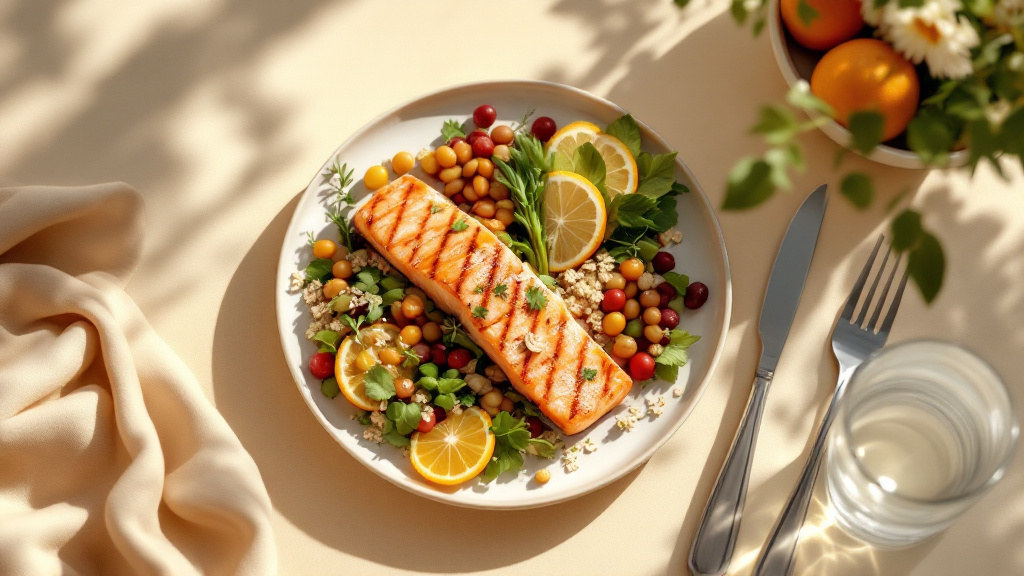
Protein is the most satiating macronutrient. A systematic review and meta-analysis of randomized trials found that higher protein intake meaningfully shifts appetite-regulating gut hormones after eating — lowering ghrelin and raising fullness signals.1 The practical move is simple: anchor each meal around a protein source before the carbs, and spread protein across the day rather than loading it all at dinner.
2. Add fiber
Fiber slows digestion and adds bulk without adding calories. A systematic review and meta-analysis of randomized controlled trials found that soluble dietary fiber supplementation modestly increased perceived satiety in healthy adults.2 Better still, fermentable fiber feeds your gut bacteria, which is part of how your body sustains its own fullness signaling. Reach for legumes, oats, vegetables, fruit and whole grains.
3. Choose high-volume, water-rich foods
People tend to eat a fairly consistent weight of food, so the trick is to make that weight cost fewer calories. That's the idea behind energy density — calories per gram. Foods high in water and fiber (vegetables, fruit, broth-based soups) have low energy density, so you get a bigger, more filling plate for the same calories. Research on energy density shows that lowering it lets people eat satisfying portions while taking in less energy.3
4. Slow down
Fullness signals take time to reach your brain, so eating pace matters. In a randomized study, eating the same meal more slowly led to lower hunger and greater fullness afterward, and slower eating lowered energy intake in normal-weight participants.4 Practical levers: put the fork down between bites, chew thoroughly, and give a meal at least 20 minutes.
5. Protect your sleep
Appetite is a whole-body system, and sleep is part of it. Reviews of sleep and appetite regulation describe how short or poor sleep can tilt your hunger hormones — nudging ghrelin up and fullness signals down — which makes staying full harder the next day.5 The evidence isn't perfectly uniform, but adequate, regular sleep is a low-cost lever worth protecting.
Where salmon peptides fit
Here's the honest connection to what we do. Beyond whole food, specific food-derived proteins and marine peptides have been studied for supporting the same satiety machinery these levers rely on. A review of proteins and peptides from food sources catalogs their effects on satiety,6 and marine-peptide research has looked at the body's own fullness hormones. The point isn't to replace protein, fiber or good habits — it's to support the same natural fullness signaling they set off.
Support your fullness signal
triGLP is bioactive salmon peptides in four clean, sublingual ingredients — made to help support the natural fullness signals your body already uses, not to override them.
See the triGLP drops// ships from the official ORYGN storefront · dietary supplement · not a drug · results vary
The honest limits
These levers are well supported, but they're tools, not magic — total calories, individual biology, stress and the rest of your routine all still matter, and results vary from person to person. Some of the evidence (sleep and appetite especially) is mixed, and the research on food-derived salmon and fish peptides is still early, much of it in cell and animal models; encouraging findings are not a promise for anyone in particular. Salmon peptides are a dietary supplement, not a medicine — they don't treat, cure, or prevent any disease. We link the studies so you can judge for yourself.
Common questions
What foods keep you full the longest?
Foods that are high in protein, high in fiber, and high in water/volume tend to keep you fullest — think lean protein, legumes, vegetables, fruit, oats and broth-based soups. They combine a strong fullness-hormone response with physical stomach filling and fewer calories per bite. Results vary by person.
Does eating slowly really help you feel full?
In randomized research, yes — eating the same meal more slowly led to less hunger and more fullness afterward, likely because satiety signals need time to register, and it lowered energy intake in normal-weight people. Putting the fork down between bites and giving a meal 20+ minutes are simple ways to apply it. Results vary.
Why do I get hungry again so quickly?
Often it's a meal that was low in protein and fiber and high in energy density — it spikes and clears fast without sending a strong, lasting fullness signal. Rebuilding meals around protein, fiber and higher-volume foods, and slowing your pace, are the evidence-aligned fixes. Total intake and sleep matter too.
Do salmon or fish peptides help you feel full?
Certain food-derived peptides, including fish and marine protein hydrolysates, have been studied for supporting the same satiety hormones that whole protein triggers. The research is still early and mostly in lab models, so it's support of a normal function — not a cure — and results vary.
References
- Effect of short- and long-term protein consumption on appetite and appetite-regulating gastrointestinal hormones: a systematic review and meta-analysis of randomized controlled trials. British Journal of Nutrition, 2020. pubmed.ncbi.nlm.nih.gov/32768415
- Unravelling the Effects of Soluble Dietary Fibre Supplementation on Energy Intake and Perceived Satiety in Healthy Adults: Systematic Review and Meta-Analysis of Randomised-Controlled Trials. Nutrients, 2019. pmc.ncbi.nlm.nih.gov/articles/PMC6352252
- Dietary energy density: Applying behavioural science to weight management. Nutrition Bulletin, 2017. pubmed.ncbi.nlm.nih.gov/29151813
- Slower eating speed lowers energy intake in normal-weight but not overweight/obese subjects. Journal of the Academy of Nutrition and Dietetics, 2014. pubmed.ncbi.nlm.nih.gov/24388483
- Sleep Deprivation and Central Appetite Regulation. Nutrients, 2022. pmc.ncbi.nlm.nih.gov/articles/PMC9783730
- Proteins and Peptides from Food Sources with Effect on Satiety and Their Role as Anti-Obesity Agents: A Narrative Review. Nutrients, 2024. ncbi.nlm.nih.gov/pmc/articles/PMC11510221