Marine collagen for weight loss: what the science actually shows
Straight up: marine collagen is a fish-derived protein, not a fat-burner — and any page promising it "melts fat" is selling you hope. What the real research supports is narrower and more useful: it's a filling protein, and when collagen peptides are paired with resistance training, controlled trials show more lean mass and less fat. Below is exactly how it works, what the trials found (and their limits), the appetite and GLP-1 angle, how to actually use it, and where marine salmon peptides fit — every claim linked.
Marine collagen doesn't cause weight loss — but it can support it two honest ways. First, it's a protein, and protein is the most filling macronutrient, so it helps you feel satisfied on fewer calories. Second, in randomized trials, collagen peptides taken alongside resistance training produced more lean (fat-free) mass and greater fat loss than training with a placebo — in one 12-week study, about 1.6 kg more fat-free mass.3 The catch: collagen is an incomplete protein, the appetite effect on its own is modest, and every bit of the weight benefit still runs through an overall calorie deficit. Marine peptides like salmon-derived hydrolysate are studied on the same GLP-1 fullness pathway. Education, not medical advice; a dietary supplement is not a drug; results vary.
On this page
Does marine collagen "make" you lose weight?
No — and it's worth being blunt about it, because the internet is full of pages implying otherwise. Weight loss comes down to taking in fewer calories than you burn over time; no powder overrides that. What collagen can do is play a supporting role — as a protein that helps with fullness, and, paired with training, as a nudge toward keeping muscle while you lose fat. That's a real, if modest, benefit. It is not a shortcut, and the honest version of this story is the whole reason to trust the rest of the page.
What marine collagen actually is
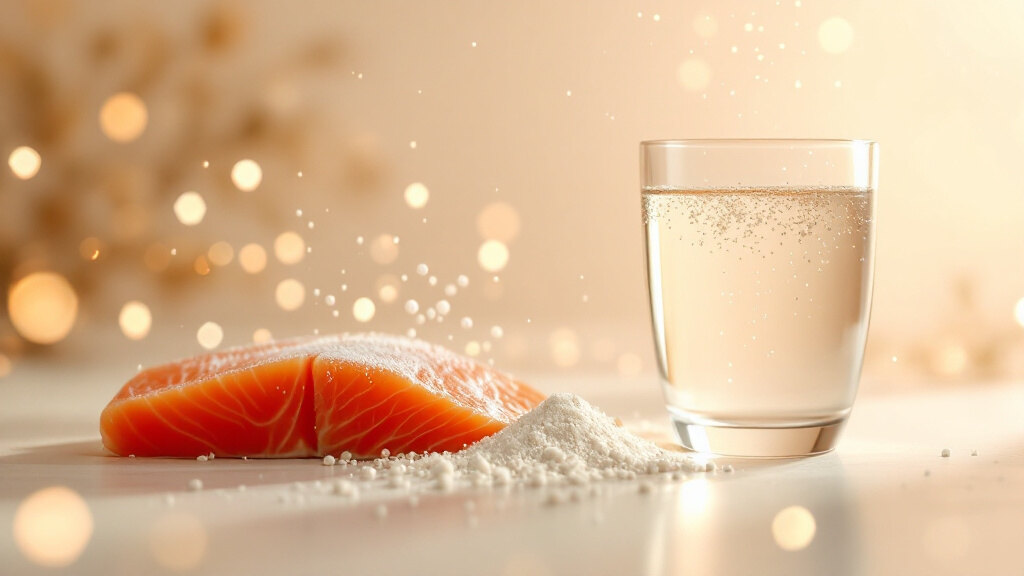
Marine collagen is hydrolyzed collagen — collagen protein sourced from fish (skin and scales) and broken down into small, easily-absorbed peptides. Chemically it's the same family of collagen peptides you'll see in "collagen powder," just from a marine rather than bovine source, which many people prefer for sustainability and absorption. The key thing to understand for weight: collagen is protein, so it carries protein's fullness and muscle-supporting properties — but it's an incomplete protein, low in some essential amino acids (notably tryptophan), so it isn't a one-to-one replacement for a complete protein like fish, eggs, or whey. That nuance matters, and we'll come back to it.
The fullness angle — and its honest limit
Of the three macronutrients, protein is the most satiating — gram for gram it fills you up more than carbohydrate or fat.5 In a classic controlled study, people who simply raised the protein in their diet and then ate freely ended up eating about 440 fewer calories a day — not through willpower, but because their appetite dropped.6 Because marine collagen is protein, a scoop adds to that daily protein total and can help take the edge off hunger. The honest limit: collagen's own appetite effect, tested head-to-head, is modest and inconsistent — some studies see a small bump in fullness hormones, others see no change in how much people eat.4 So use it as one contributor to your protein target, not as a standalone appetite switch.
"Marine collagen doesn't override the calorie math — it adds filling protein and, with training, helps you keep the muscle while you lose the fat."
What the body-composition trials found
The most useful evidence for weight isn't about the scale — it's about body composition, i.e. losing fat while keeping muscle. Three randomized controlled trials from the same research line tell a consistent story, and all of them pair collagen peptides with resistance training:
- Elderly men with sarcopenia (2015): 53 men did 12 weeks of resistance training; the group taking 15 g of collagen peptides daily gained significantly more fat-free mass and lost significantly more fat than the placebo group.1
- Premenopausal women (2019): 77 women, 12 weeks of training; collagen peptides produced a significantly higher increase in fat-free mass and a greater reduction in fat mass versus placebo.2
- Middle-aged untrained men (2021): 97 men trained for 12 weeks; collagen peptides led to about 1.6 kg more fat-free mass gained than placebo.3
Read them honestly: these are body-composition wins — more muscle, less fat — not big drops on the scale, and the effect showed up with training, not from the powder alone. That's exactly why collagen is a supporting player: it helps the fat you lose come from fat, not muscle.
Try triGLP
triGLP is bioactive salmon protein hydrolysate in clean, sublingual drops — a marine peptide dietary supplement made to support the natural GLP-1 fullness signaling your body already uses.
Get triGLP// ships from the official ORYGN storefront · dietary supplement · not a drug · results vary
Appetite, GLP-1 and marine peptides
There's growing interest in whether marine peptides nudge the body's own fullness hormones. A 2025 randomized trial found collagen peptides could influence post-exercise appetite physiology — small shifts in GLP-1, insulin and ghrelin — though the effect size was modest.4 More specific to salmon: in laboratory studies, salmon-derived bioactive peptides activated the GLP-1 and GIP receptors involved in satiety signaling,7 and food proteins and their hydrolysates are an active area of GLP-1 research.8 None of this makes a peptide a drug — GLP-1 medications work at a completely different intensity. It means marine peptides are studied on the same natural pathway your body uses to say "I'm full," which is a support role, not a substitute.
How to actually use it
If you want marine collagen to earn its place in a weight-loss plan, here's the evidence-aligned way to use it:
- Dose: the trials used around 10–15 g of collagen peptides a day. That's the range that showed body-composition benefits.3
- Pair it with resistance training: the muscle-and-fat benefits appeared with training. Collagen without lifting is just a small protein top-up.1
- Don't let it replace complete protein: because collagen is incomplete, keep fish, eggs, dairy or a complete protein as your main source and use collagen as an add-on, not the whole plan.
- It still lives inside a calorie deficit: collagen supports the plan; it doesn't replace eating fewer calories than you burn.
Where salmon peptides fit
Marine collagen is one kind of fish peptide; salmon peptides (salmon protein hydrolysate) are another — and they're the ones studied most directly on the fullness pathway. Rather than leaning on collagen's incomplete amino-acid profile, salmon-derived bioactive peptides have been shown in lab studies to activate the GLP-1 and GIP receptors tied to satiety.7 So a supplement like triGLP is positioned to support the natural fullness signaling your body already runs — as a complement to eating well and training, not a replacement for real food or a calorie deficit. For the deeper dive, see salmon peptides benefits, salmon protein hydrolysate, and protein for satiety.
The honest limits
Marine collagen supports weight goals — it does not cause weight loss. The whole effect runs through eating fewer calories overall and, for the body-composition benefit, through actually training; add collagen on top of everything else you eat and skip the workouts, and nothing changes on the scale. Collagen is an incomplete protein, so it shouldn't crowd out complete protein sources, and its standalone appetite effect is modest and inconsistent. The direct evidence for the exact phrase "marine collagen for weight loss" is thin — most of the strong data is on collagen peptides plus resistance training improving fat-free mass, not on marine collagen dropping pounds by itself. Anyone with a fish or shellfish allergy should avoid marine collagen and marine-derived products entirely. Marine collagen and salmon peptides are dietary supplements, not medicines — they don't diagnose, treat, cure, or prevent any condition, and they support your natural fullness signaling rather than acting like an appetite drug. This page is educational, not medical advice. Results vary.
Common questions
Does marine collagen actually help you lose weight?
Not on its own. Marine collagen is a fish-derived protein, and protein helps you feel full on fewer calories, which makes a calorie deficit easier to sustain. Its most reliable benefit is body composition: in randomized trials, collagen peptides paired with resistance training built more lean mass and trimmed more fat than training with a placebo. But the weight change still comes from the overall calorie deficit — collagen supports the plan rather than causing weight loss. Results vary.
How much marine collagen should I take for weight loss?
The trials that showed body-composition benefits used about 10–15 grams of collagen peptides per day, alongside a resistance-training program. That's a reasonable, evidence-aligned range. Take it as an add-on to a diet that already includes complete protein sources, keep training, and remember it works inside a calorie deficit — not instead of one. Results vary.
Is marine collagen better than regular (bovine) collagen for weight?
For weight and body composition, the meaningful factor is that both are collagen peptides — the marine-versus-bovine difference is mostly about source, sustainability, and personal preference, not a proven weight advantage. Marine collagen is popular for its small peptide size and fish origin. Whichever you choose, the same honest rules apply: it's a supporting protein, it works best with training, and it lives inside a calorie deficit. Results vary.
Does marine collagen suppress appetite?
Modestly and inconsistently. Because it's protein, it contributes to fullness, and one 2025 trial found collagen peptides could nudge post-exercise fullness hormones like GLP-1 — but the effect was small, and some studies find no change in how much people actually eat. Treat marine collagen as one contributor to your daily protein target, not as a standalone appetite suppressant. Results vary.
Do salmon peptides work the same way as marine collagen?
They're both marine (fish-derived) peptides, but salmon protein hydrolysate is the one studied most directly on the fullness pathway — in lab studies it activated the GLP-1 and GIP receptors involved in satiety signaling. Collagen is an incomplete protein studied mostly for body composition with training; salmon peptides are studied on the natural satiety pathway. A supplement like triGLP is positioned to support that fullness signaling as a complement to eating well, not a replacement for food or a calorie deficit. The science is early; results vary.
References
- Collagen peptide supplementation in combination with resistance training improves body composition and increases muscle strength in elderly sarcopenic men: a randomised controlled trial. Zdzieblik D, et al. Br J Nutr. 2015;114(8):1237–1245 (PMC/NIH). ncbi.nlm.nih.gov/pmc/articles/PMC4594048
- Specific Collagen Peptides in Combination with Resistance Training Improve Body Composition and Regional Muscle Strength in Premenopausal Women: A Randomized Controlled Trial. Jendricke P, et al. Nutrients. 2019;11(4):892 (PubMed/NIH). pubmed.ncbi.nlm.nih.gov/31010031
- The Influence of Specific Bioactive Collagen Peptides on Body Composition and Muscle Strength in Middle-Aged, Untrained Men: A Randomized Controlled Trial (~1.6 kg greater fat-free mass vs placebo). Int J Environ Res Public Health. 2021;18(9):4837 (PMC/NIH). ncbi.nlm.nih.gov/pmc/articles/PMC8125453
- The effects of collagen peptide supplementation on appetite and post-exercise energy intake in females: a randomised controlled trial. Br J Nutr. 2025 (PubMed/NIH). pubmed.ncbi.nlm.nih.gov/40685650
- The satiating power of protein — a key to obesity prevention? Halton TL, Hu FB. J Am Coll Nutr (PubMed/NIH). pubmed.ncbi.nlm.nih.gov/16002791
- A high-protein diet induces sustained reductions in appetite, ad libitum caloric intake, and body weight (~440 kcal/day). Weigle DS, et al. Am J Clin Nutr. 2005;82(1):41–48 (PubMed/NIH). pubmed.ncbi.nlm.nih.gov/16002798
- Initial Exploration of the In Vitro Activation of GLP-1 and GIP Receptors and Pancreatic Islet Cell Protection by Salmon-Derived Bioactive Peptides. Mar Drugs. 2024;22(11):490 (PMC/NIH). ncbi.nlm.nih.gov/pmc/articles/PMC11595994
- Glucagon-like peptide-1 regulation by food proteins and protein hydrolysates. Review, 2021 (PubMed/NIH). pubmed.ncbi.nlm.nih.gov/33461642