How to stop eating so much
Here's what most advice misses: eating too much is driven more by how much is in front of you and how fast you eat it than by weak willpower. That's why "just eat less" fails — and why the fixes that work change the portion, the pace, and the environment, not your resolve. Below are the natural levers with real evidence: slowing down so your fullness signals can catch up, right-sizing the plate, front-loading protein and fiber, and taming the cues that push seconds — plus where salmon peptides fit. No hype, every claim linked.
You eat so much mostly because of portion size, eating speed, and your food environment — not a character flaw. Bigger portions reliably make people eat more without feeling any fuller,3 and eating fast means you've overeaten before your fullness signals even arrive — they lag roughly 20 minutes.1 So the levers that work are: slow down (put the fork down between bites), right-size the portion and the plate, lead with protein, fiber and volume so you're satisfied on less, and fix the environment (no serving dishes on the table, no eating from the package, no screen). Bioactive salmon peptides are studied because they may support that same GLP-1 fullness pathway. Honest caveat: appetite is personal and stubborn — there's no off-switch. This is education, not medical advice; results vary.
On this page
Why we eat so much — and why it's usually not willpower
When researchers actually measure what makes people overeat, two forces dominate, and neither is moral weakness. The first is portion size: give people a bigger serving and they eat more of it — in one classic study, a larger portion of the same dish led to about 30% more calories eaten, and, crucially, people did not report feeling any fuller afterward.3 The second is eating speed: fullness is a signal your gut sends your brain, and it takes time to build — so if you eat fast, you can blow past "enough" before the signal ever lands.1 The good news is that both are fixable by changing the setup, not by gritting your teeth. The levers below each pull on portion, pace, the biology of fullness, or the environment.
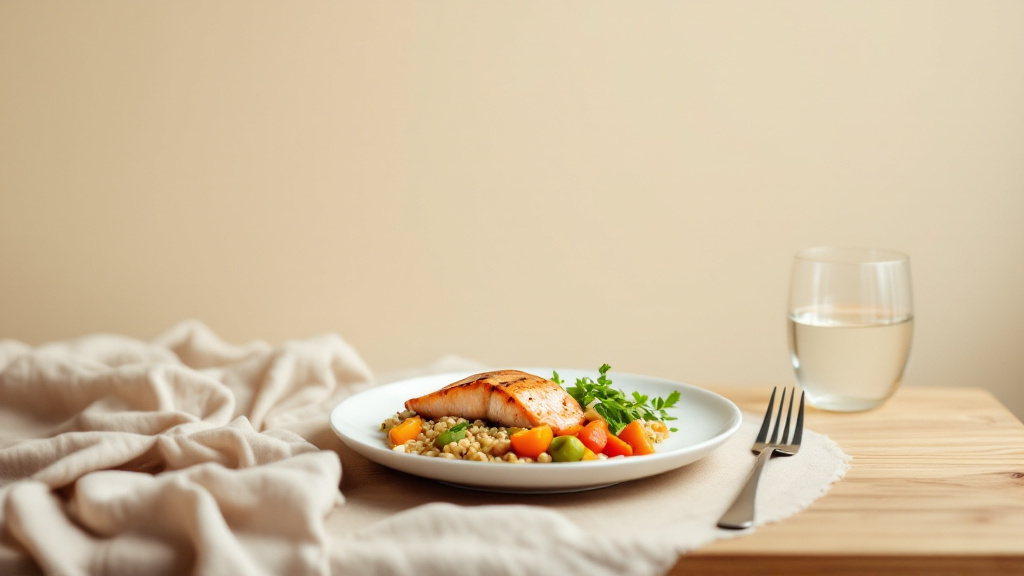
Lever 1: Slow down — let fullness catch up
Your fullness hormones — GLP-1, CCK and PYY — are released as food arrives and stretches the gut, but the message reaches your brain on a delay. Eat quickly and you've cleared the plate before it registers. In controlled research, eating at a slower rate lowered how much people ate and left them less hungry, with a bigger post-meal rise in the "I'm satisfied" signals and greater suppression of the hunger hormone ghrelin.12 Practical version:
- Put the fork down between bites. It sounds trivial; it's the single most reliable way to cut your eating rate.
- Chew more, sip water. Both stretch the meal past the ~20-minute mark where fullness kicks in.
- Serve, then pause. Wait a few minutes before deciding on seconds — the urge often fades once the signal arrives.
"You're not fighting your appetite — you're giving it time to speak. Fullness is always a few minutes behind the fork."
Lever 2: Right-size the portion and the plate
The portion in front of you is the strongest silent driver of how much you eat, and it works whether you're lean or not, and regardless of how hungry you started.3 Bigger servings simply get eaten — and because fullness signals get overridden, you don't feel the difference until later. So the fix is to decide the amount before you sit down, not while the food is in front of you:
- Plate it in the kitchen. Keep serving dishes off the table so a refill takes a deliberate trip, not an absent-minded scoop.
- Use a smaller plate and glass. A normal portion looks generous on a smaller plate and skimpy on a large one — your eyes anchor to the plate, not the grams.
- Never eat from the package. Portion snacks and leftovers onto a dish first; the bag has no bottom your brain respects.
- Bulk the plate with vegetables. Filling half the plate with low-calorie, high-volume veg means a satisfying amount of food for far fewer calories.
Lever 3: Front-load protein, fiber & volume
What you eat first changes how much you eat overall. Protein is the strongest fullness lever: controlled trials show it lowers hunger and raises fullness by boosting your own GLP-1, PYY and CCK.4 Fiber and water/volume add bulk that fills the stomach for few calories — the properties that made high-satiety foods (boiled potatoes, oats, fish, legumes) rank so well when researchers measured fullness directly.5 Put together: start the meal with the protein and the vegetables, and the drive to keep eating gets quieter on its own. See our foods that keep you full and protein for satiety pages for the deeper dive.
Try triGLP
triGLP is bioactive salmon protein hydrolysate in clean, sublingual drops — a dietary supplement made to support the natural GLP-1 fullness signaling your body already uses.
Get triGLP// ships from the official ORYGN storefront · dietary supplement · not a drug · results vary
Lever 4: Fix the eating environment
A lot of "eating so much" is the room, not the appetite. The same portion research shows people override their own fullness when the food keeps coming,3 and distraction makes it worse — when your attention is on a screen, you register less of what you ate and tend to eat more later. Set the table for less:
- Eat at a table, off a plate, without a screen. Attention on the meal = better registration of fullness.
- Don't graze from communal bowls. Family-style serving quietly adds portions you never decided to eat.
- Protect your sleep. Short sleep tips your hunger hormones toward wanting more, especially higher-calorie food — so a good night makes every other lever easier.
- Don't arrive starving. Skipping meals leads to eating fast and past full at the next one; a steady protein-anchored rhythm prevents the rebound.
Where salmon peptides fit
The biology under every lever above is your body's own GLP-1 fullness pathway — the signal that slowing down lets catch up, that protein raises, and that big portions override. That's exactly the pathway bioactive salmon peptides (salmon protein hydrolysate) are studied for: in laboratory studies, salmon-derived peptides activated the GLP-1 and GIP receptors involved in satiety,7 and food proteins and their hydrolysates are an active area of GLP-1 research for exactly this reason.6 So the idea behind a supplement like triGLP is to support the same fullness signaling that slowing down and eating protein work on — a food-derived nudge to help "enough" feel like enough, not a drug and not a substitute for right-sizing the plate. It's one tool in the stack.
How strong is the evidence?
- Portion size drives intake — strong. Larger portions reliably increase calories eaten across people and settings, and fullness signals get overridden.3
- Eating slower lowers intake — supportive. Slower eating reduced energy intake and hunger and shifted satiety hormones in controlled studies (effect can be smaller in some groups).12
- Protein → satiety hormones — strong and consistent. Human trials show protein raises GLP-1/PYY/CCK and lowers hunger.4
- Fiber & volume — strong. Established by the Satiety Index across common foods.5
- Salmon peptides on the GLP-1 pathway — early. Real laboratory receptor activity;7 supportive, not proof of an eating-behavior effect in you.
The honest limits
No supplement, food, or trick makes you "eat less" on command — appetite is a habit-and-biology system that varies hugely person to person. The strongest evidence sits with the boring, free stuff: smaller portions, slower pace, protein and fiber, protected sleep. The slower-eating effect can be smaller in some people (for example, it lowered intake more in normal-weight than in overweight participants in one trial), so treat it as a helpful lever, not a guarantee.1 Salmon-peptide research on the GLP-1 pathway is genuinely interesting but early (mostly laboratory studies). Salmon peptides are a dietary supplement, not a medicine — they don't diagnose, treat, cure, or prevent any condition, and they won't override a big plate on their own. Anyone with a fish allergy should avoid them. If eating feels compulsive, tied to low mood, or part of disordered eating, please talk to a clinician — this page is educational, not medical advice. Results vary.
Common questions
What's the fastest way to stop eating so much?
Change the setup, not your willpower: serve a smaller portion in the kitchen (keep serving dishes off the table), use a smaller plate, and eat slowly — put the fork down between bites so your fullness signals, which lag about 20 minutes, can catch up. Lead the meal with protein and vegetables. No single trick works for everyone; results vary.
Why do I eat so much even when I'm not that hungry?
Because the amount in front of you and how fast you eat matter more than hunger. Research shows bigger portions get eaten — with people not feeling any fuller — and fast eating means you overshoot "enough" before the fullness signal arrives. Fixing the portion, the pace, and the environment beats relying on willpower. Results vary.
Does eating slowly really make you eat less?
In controlled studies, a slower eating rate lowered how much people ate and left them less hungry, with a stronger post-meal rise in satiety hormones. The effect can be smaller in some people, so it's a helpful lever rather than a guarantee. The simplest way to slow down is to put your fork down between bites and sip water. Results vary.
Do smaller plates actually help?
They help because the portion you serve is the strongest driver of how much you eat, and your eyes anchor to the plate. A normal amount looks generous on a smaller plate and skimpy on a large one, so smaller dishware nudges a smaller serving — especially when you plate the food in the kitchen and keep serving dishes off the table. Results vary.
How do salmon peptides fit into eating less?
Eating less works largely by letting your body's GLP-1 fullness signal do its job. Salmon peptides are studied because, in laboratory studies, they activated the GLP-1 and GIP receptors involved in satiety — the same pathway protein and slowing down support. So they're positioned to support natural fullness signaling as a dietary supplement, to help "enough" feel like enough — not to work like a drug or replace right-sizing the plate. The science is early; results vary.
Is it bad to eat a lot in one sitting?
Occasionally, no — appetite naturally varies day to day. The issue is a routine of large, fast, distracted meals that override your fullness signals. The goal isn't to eat as little as possible; it's to eat an amount that leaves you satisfied without overshooting, by fixing portion, pace, and environment. Results vary.
References
- Slower eating speed lowers energy intake in normal-weight but not overweight/obese subjects. (PubMed/NIH). pubmed.ncbi.nlm.nih.gov/24388483
- Slow Down: Behavioural and Physiological Effects of Reducing Eating Rate. Nutrients (PMC/NIH). ncbi.nlm.nih.gov/pmc/articles/PMC6357517
- Portion size of food affects energy intake in normal-weight and overweight men and women. Rolls BJ, et al. Am J Clin Nutr. (PubMed/NIH). pubmed.ncbi.nlm.nih.gov/12450884
- Effect of short- and long-term protein consumption on appetite and appetite-regulating gastrointestinal hormones: a systematic review and meta-analysis of randomized controlled trials. (PubMed/NIH). pubmed.ncbi.nlm.nih.gov/32768415
- A Satiety Index of common foods. Holt SHA, et al. Eur J Clin Nutr. 1995;49(9):675–690 (PubMed/NIH). pubmed.ncbi.nlm.nih.gov/7498104
- Glucagon-like peptide-1 regulation by food proteins and protein hydrolysates. Review, 2021 (PubMed/NIH). pubmed.ncbi.nlm.nih.gov/33461642
- Initial Exploration of the In Vitro Activation of GLP-1 and GIP Receptors and Pancreatic Islet Cell Protection by Salmon-Derived Bioactive Peptides. Marine Drugs, 2024;22(11):490 (PMC/NIH). ncbi.nlm.nih.gov/pmc/articles/PMC11595994