Foods that keep you full
Fullness isn't about calories — it's about what a food does in your gut. The classic Satiety Index study fed people equal-calorie portions of 38 foods and found three things predicted how long they stayed full: protein, fiber, and water/volume (low energy density). Below are the most filling foods, why they work, and where salmon peptides fit — no hype, every claim linked.
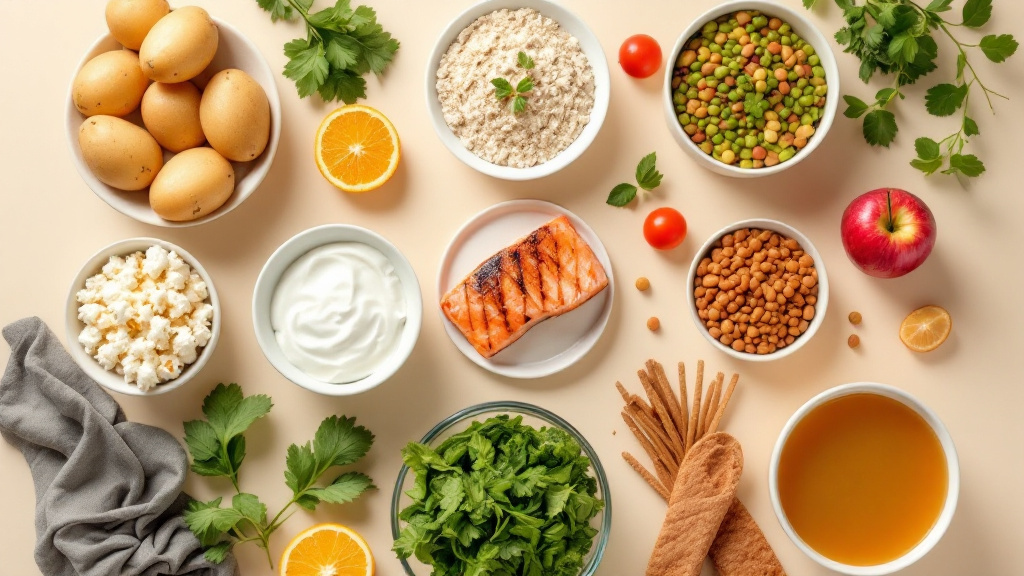
The most filling foods are high in protein, fiber, or water/volume — and low in energy density (few calories per gram). In the original Satiety Index research, boiled potatoes ranked most filling of all, followed by high-protein foods like fish and lean meat, then oatmeal, fruit, and eggs; sugary, fatty, low-fiber foods ranked lowest.1 Practical shortlist: potatoes, eggs, oats, fish and lean protein, Greek yogurt, beans and lentils, apples and citrus, popcorn, broth-based soup, and non-starchy vegetables. Protein does the heaviest lifting because it raises your own fullness hormones — GLP-1, PYY and CCK. Bioactive salmon peptides are studied because they may support that same GLP-1 fullness pathway. Honest caveat: this is education, not medical advice; results vary.
On this page
Why some foods keep you full — and it isn't calories
Two foods with the exact same calories can leave you feeling completely different an hour later. A croissant and a bowl of oatmeal can carry the same energy, yet one has you hunting the cupboard by mid-morning and the other doesn't. That gap is satiety — how well a food satisfies you and holds off the next hunger signal — and it's driven by the food's makeup, not its calorie count. When researchers measured it directly, three properties stood out: protein content, fiber content, and water/volume (which together lower a food's energy density, the calories per gram). Fat and refined carbohydrate, by contrast, did nothing for fullness.1 Get those three levers on your plate and you stay full longer on the same — or fewer — calories.
The Satiety Index: the study that ranked fullness
In 1995, researchers at the University of Sydney did something clever: they fed people equal-calorie (240-calorie) portions of 38 common foods and then tracked how full each one kept them over the next two hours, plus how much they ate afterward. The result was the Satiety Index, scored against white bread set at 100%.1 The findings flipped a lot of diet folklore:
| Food | Satiety Index |
|---|---|
| Boiled potatoes | 323% |
| Fish | 225% |
| Oatmeal / porridge | 209% |
| Oranges | 202% |
| Apples | 197% |
| Beef (lean) | 176% |
| Baked beans | 168% |
| Eggs | 150% |
| White bread (reference) | 100% |
| Cake | 65% |
| Croissant | 47% |
Boiled potatoes scored a remarkable 323% — seven times more filling than the croissant at the bottom.1 Notice the pattern: the winners are watery, high-fiber, or protein-rich; the losers are dense, fatty, sugary, and low-fiber. The next three sections unpack the three levers that decide where a food lands.
Lever 1: Protein — the strongest signal
Protein is the most powerful fullness lever, and the reason is biological. When you eat it, your gut releases satiety hormones — GLP-1, PYY and CCK — that tell your brain you've had enough. A meta-analysis of controlled human trials found protein lowered hunger and the desire to eat and raised fullness, tracking with those gut hormones.2 It holds at the snack level too: high-protein snacks blunt appetite and drive stronger satiety-hormone responses than fatty snacks of the same size.3 That's why fish, lean meat, eggs, Greek yogurt, and legumes cluster near the top of any fullness ranking — and why anchoring each meal with protein is the single highest-yield change most people can make.
"Calories tell you what a food costs. Protein, fiber, and water tell you what it's worth to your hunger."
Lever 2: Fiber — bulk that slows everything down
Fiber earns its place two ways. It adds physical bulk so a portion fills more of your stomach for the same calories, and soluble fiber forms a gel that slows how fast your stomach empties — so the food's fullness lingers instead of spiking and fading. In the Satiety Index data, fiber content correlated positively with how filling a food was.1 This is why oats (beta-glucan), beans and lentils, apples, oranges, and vegetables punch far above their calories. Fiber also feeds the gut bacteria that help produce your satiety hormones downstream — the same GLP-1 pathway protein works on. Aim to build meals around foods that arrive with their fiber intact rather than stripped out.
Lever 3: Water & volume — low energy density
Your stomach registers how much you ate as much as how many calories it carried. Foods with high water content — soups, fruit, vegetables, potatoes — take up space and stretch the stomach, sending fullness signals, without piling on calories. That's the concept of energy density: calories per gram. Water and fiber lower it; fat and sugar raise it. The Satiety Index found water/volume was one of the three properties that tracked with fullness,1 and it explains a practical trick: a broth-based soup or a big salad before a meal takes the edge off appetite for almost no calories. Drinking a glass of water isn't the same — it leaves the stomach fast — but water bound inside food is a genuine fullness lever.
The most filling foods, and why
- Boiled potatoes — the Satiety Index champion. High water and fiber, low energy density, and resistant starch when cooled. Boiled or baked, not fried.1
- Eggs — complete protein with fat and micronutrients; a protein-rich breakfast consistently blunts later hunger.2
- Oats / oatmeal — soluble beta-glucan fiber that gels and slows gastric emptying; scored ~209% on the Index.1
- Fish and lean protein — among the most satiating foods tested; high protein, low energy density.1
- Greek yogurt (plain) — protein-dense and thick; keeps you full far longer than a sugary flavored cup.
- Beans and lentils — the rare protein-plus-fiber combo, hitting two levers at once.
- Apples and citrus — high water and fiber; whole fruit fills more than juice, which strips both.1
- Air-popped popcorn — a lot of chewy volume and fiber for very few calories: high satiety per calorie.
- Broth-based soup — water bound into a meal; a starter soup measurably lowers how much you eat after.
- Non-starchy vegetables — maximum volume and fiber for minimal calories; the free lever on any plate.
- Nuts (a portioned handful) — protein, fiber and fat; swapping them in as a snack reduced cravings and improved diet quality in a controlled trial.4
Try triGLP
triGLP is bioactive salmon protein hydrolysate in clean, sublingual drops — a dietary supplement made to support the natural GLP-1 fullness signaling your body already uses.
Get triGLP// ships from the official ORYGN storefront · dietary supplement · not a drug · results vary
How to build a filling plate
You don't need to memorize the table — just stack the three levers on every plate:
- Anchor with protein. Fish, eggs, lean meat, Greek yogurt, beans — this is the strongest lever, so make it the first thing you plate.2
- Add real fiber. Whole fruit, oats, legumes, or vegetables — arriving with their fiber intact, not stripped into juice or refined flour.1
- Bring the volume. A broth soup or a big pile of non-starchy veg lowers the plate's energy density so you fill up on fewer calories.1
- Spend calories carefully on the low-satiety stuff. Croissants, cake, chips and sugary drinks are the bottom of the Index — enjoy them, just don't expect them to keep you full.1
Where salmon peptides fit
The through-line under every lever above is your body's own GLP-1 fullness pathway — the hormone signal that protein, fiber, and steady meals all work to raise. That's exactly the pathway bioactive salmon peptides (salmon protein hydrolysate) are studied for: in laboratory studies, salmon-derived peptides activated the GLP-1 and GIP receptors involved in satiety.5 Food proteins and their hydrolysates are an active area of GLP-1 research for exactly this reason.6 So the idea behind a supplement like triGLP is to support the same fullness signaling that filling foods work on — a food-derived nudge, not a drug and not a replacement for a plate built around protein, fiber, and volume. It's one tool in the stack. See our how to feel full longer and protein for satiety pages for the deeper dive.
How strong is the evidence?
- Protein, fiber and water/volume drive fullness — strong. Established directly by the Satiety Index study across 38 equal-calorie foods.1
- Protein → satiety hormones — strong and consistent. Human meta-analysis and snack-level trials show protein raises GLP-1/PYY/CCK and lowers hunger.23
- Filling-food swaps help — supportive. Swapping nuts in as a snack cut cravings and improved diet quality in a controlled trial.4
- Salmon peptides on the GLP-1 pathway — early. Real laboratory receptor activity;5 supportive, not proof of a fullness effect in you.
- Reality check. Satiety varies person to person, and how a food is prepared (fried vs. boiled, juiced vs. whole) can move it up or down the ranking.
The honest limits
The Satiety Index tested single foods in one small study — it's a brilliant guide, not gospel, and individual fullness varies a lot. Preparation matters: a boiled potato fills you, fries don't; whole fruit fills you, juice doesn't. No food "melts fat" or works like a medication, and eating filling foods helps with appetite but isn't a weight-loss guarantee on its own. Salmon-peptide research on the GLP-1 pathway is genuinely interesting but early (mostly laboratory studies). Salmon peptides are a dietary supplement, not a medicine — they don't diagnose, treat, cure, or prevent any condition. Anyone with a fish allergy should avoid them. If your appetite feels impossible to satisfy or is tied to a medical condition, talk to a clinician — this page is educational, not medical advice. Results vary.
Common questions
What food keeps you full the longest?
In the classic Satiety Index study, boiled potatoes kept people fullest of the 38 foods tested — about seven times more filling than a croissant of the same calories — thanks to high water, fiber, and low energy density. Among protein foods, fish and lean meat ranked highest. In practice the most filling meals combine protein, fiber, and water/volume. Results vary.
Why do some foods keep you full and others don't?
Because fullness comes from what a food does in your gut, not its calorie count. Research found three properties predict satiety: protein (which raises fullness hormones), fiber (bulk plus slowed digestion), and water/volume (which lowers energy density so you eat more grams for fewer calories). Fat and refined carbohydrate did not track with fullness. Results vary.
What are the best high-protein foods for staying full?
Fish, eggs, lean meat, plain Greek yogurt, and legumes (beans, lentils) are top choices — legumes are especially good because they bring fiber along with protein. Protein is the strongest fullness lever because it raises your body's own GLP-1, PYY, and CCK signals. Anchoring each meal with protein is the highest-yield change most people can make. Results vary.
Do high-fiber foods really help you feel full?
Yes. Fiber adds physical bulk so a portion fills more of your stomach for the same calories, and soluble fiber (like the beta-glucan in oats) forms a gel that slows stomach emptying, so fullness lasts longer. Oats, beans, apples, oranges, and vegetables are strong choices. In the Satiety Index, higher-fiber foods were more filling. Results vary.
How do salmon peptides fit into eating to stay full?
Filling foods work largely by raising your body's GLP-1 fullness signal. Salmon peptides are studied because, in laboratory studies, they activated the GLP-1 and GIP receptors involved in satiety — the same pathway. So they're positioned to support natural fullness signaling as a dietary supplement alongside a plate built on protein, fiber, and volume — not to work like a drug or replace real food. The science is early; results vary.
Is it about calories or the type of food?
Both matter, but for fullness the type of food matters more. Two 240-calorie portions can leave you feeling completely different: the one high in protein, fiber, or water keeps you satisfied while the dense, fatty, sugary one doesn't. Choosing higher-satiety foods helps you feel full on the same or fewer calories. Results vary.
References
- A Satiety Index of common foods. Holt SHA, Brand Miller JC, Petocz P, Farmakalidis E. European Journal of Clinical Nutrition. 1995;49(9):675–690 (PubMed/NIH). pubmed.ncbi.nlm.nih.gov/7498104
- Effect of short- and long-term protein consumption on appetite and appetite-regulating gastrointestinal hormones: a systematic review and meta-analysis of randomized controlled trials. (PubMed/NIH). pubmed.ncbi.nlm.nih.gov/32768415
- Exploring the effects of high protein versus high fat snacks on satiety, gut hormones and insulin secretion in women with overweight and obesity: a randomized clinical trial. (PMC/NIH). pmc.ncbi.nlm.nih.gov/articles/PMC12513319
- Consuming Tree Nuts Daily as Between-Meal Snacks Reduces Food Cravings and Improves Diet Quality in American Young Adults at High Metabolic Syndrome Risk. (PMC/NIH). ncbi.nlm.nih.gov/pmc/articles/PMC12694199
- Initial Exploration of the In Vitro Activation of GLP-1 and GIP Receptors and Pancreatic Islet Cell Protection by Salmon-Derived Bioactive Peptides. Marine Drugs, 2024;22(11):490 (PMC/NIH). ncbi.nlm.nih.gov/pmc/articles/PMC11595994
- Glucagon-like peptide-1 regulation by food proteins and protein hydrolysates. Review, 2021 (PubMed/NIH). pubmed.ncbi.nlm.nih.gov/33461642