Foods that boost GLP-1
No single food is a GLP-1 drug — but the research is clear that certain everyday foods give your body's own GLP-1 a stronger nudge than others. Here's the real, cited grocery list: what to put on your plate, why the science says it helps, and where the honest limits are.
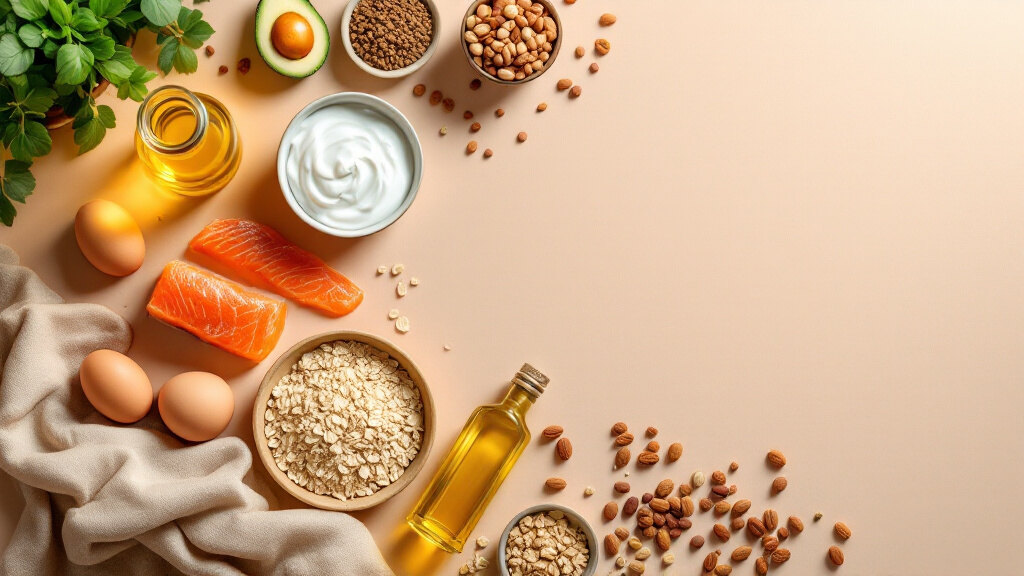
Three families of food have the best evidence for supporting your natural GLP-1: protein-dense foods (fish & seafood, eggs, Greek yogurt, lean poultry), fermentable-fiber foods (oats, barley, beans and lentils), and monounsaturated-fat foods (olive oil, avocado, nuts).12 A 2025 joint advisory from four nutrition and obesity societies specifically encourages beans, dairy, seafood, eggs, and nuts for this reason.2 These support the GLP-1 you already make — they don't replicate a prescription drug. Results vary.
On this page
How food raises GLP-1
GLP-1 is released by cells in your gut when they detect what you've eaten. Three nutrient signals do most of the lifting: protein (and specific amino acids and peptides), fermentable fiber (which your gut bacteria turn into short-chain fatty acids that trigger GLP-1-making cells), and monounsaturated fat (which activates fat-sensing receptors on those same cells).1 So "foods that boost GLP-1" really means: foods rich in those three things. Below is the list, by category.
"There's no magic GLP-1 food — there's a pattern of foods, and the science points at the same short grocery list every time."
Fish & seafood
Seafood is a standout protein for GLP-1 — and it's our lane. Fish protein is a strong GLP-1 trigger, and specific fish-derived peptides interact with the body's incretin system: a protein hydrolysate from Atlantic salmon activated GLP-1 and GIP receptors and inhibited the DPP-IV enzyme that breaks GLP-1 down in laboratory studies.31 The 2025 societies' advisory lists seafood among the foods to encourage.2 Salmon, cod, and other lean fish give you high-quality protein with the marine peptides researchers find most interesting.
Eggs
Eggs are a compact, high-quality protein that reviews of GLP-1-supporting foods repeatedly name.1 They're on the "encourage" list in the 2025 nutrition advisory alongside dairy and lean poultry, valued as nutrient-dense protein that supports satiety.2 A protein-forward breakfast built around eggs is one of the simplest ways to front-load protein — the macronutrient with the biggest GLP-1 effect.
Greek yogurt & dairy
Dairy is interesting because it brings two GLP-1 signals: protein and calcium, which together stimulate GLP-1 release.4 Whey protein in particular is a potent GLP-1 stimulator — in obese subjects, its appetite-suppressing and GLP-1-raising effects tracked with specific circulating amino acids.5 Greek yogurt and cottage cheese are the practical picks: high protein, low volume.2
Oats, barley & legumes
This is the fiber lever, and it works through your gut microbiome. Fermentable fiber — the beta-glucan in oats and barley, and the fiber in beans, lentils and peas — is fermented into short-chain fatty acids that activate GLP-1-producing cells.6 Barley beta-glucan raised GLP-1 by increasing short-chain fatty acid production, and legumes reliably increase satiety versus legume-free meals of the same calories.62 The catch: fiber is a consistency game — an everyday high-fiber pattern, not one dose.
Olive oil, avocado & nuts
The right fats help too. Monounsaturated fats — the kind in olive oil, avocado, and nuts — stimulate GLP-1 through fat-sensing receptors on gut cells.7 In humans, olive oil and hydrolyzed pine-nut oil augmented GLP-1 secretion, and MUFA-rich diets improved glucose tolerance with greater GLP-1 output in controlled studies.87 The move isn't to load up on fat — it's to make the fat in your meals the quality kind: a drizzle of olive oil, half an avocado, a small handful of nuts.
The salmon-peptide angle
triGLP is a dietary supplement built on bioactive salmon peptides — the marine-protein fragments researchers study for supporting the body's own GLP-1. Think of it as the concentrated version of the "eat more fish" idea, meant to sit alongside a GLP-1-friendly plate.
See the triGLP drops// ships from the official ORYGN storefront · dietary supplement · not a drug · results vary
The honest limits
These foods can support your body's own GLP-1 — but the effect is modest, it builds over time, and it varies a lot from person to person. Some of the mechanistic evidence is from cell or animal studies, and no food or combination of foods replicates prescription GLP-1 medications, which are a different category with much larger effects. Nothing here treats, cures, or prevents any disease. This page is educational, not medical advice — talk to your clinician about your own situation. We link the studies so you can weigh the evidence yourself.
Common questions
What is the #1 food to boost GLP-1?
There isn't a single magic food, but if you had to pick one lever it's protein — and among proteins, fish/seafood, eggs, and Greek yogurt have the best support. Protein produces the largest GLP-1 response of the macronutrients. Pair it with fermentable fiber (oats, beans) and a little monounsaturated fat (olive oil, avocado) and you've hit all three signals. Results vary.
Do these foods work like Ozempic or a GLP-1 drug?
No. Prescription GLP-1 medications like semaglutide have strong human clinical-trial evidence and large effects. Food gently supports the GLP-1 your body already makes — a much smaller, supportive nudge, not a replacement. They're different categories, and this page is educational, not medical advice. Results vary.
Does fiber really raise GLP-1?
Fermentable fiber does — your gut bacteria ferment it into short-chain fatty acids that activate GLP-1-producing cells. Oats and barley (beta-glucan) and legumes are the standouts, and legumes reliably boost satiety. The key is consistency: a genuinely high-fiber daily pattern, not a single dose. Results vary.
What should a "GLP-1 meal" look like?
Anchor it with a real protein (fish, eggs, Greek yogurt, or lean poultry), add fermentable fiber (beans, lentils, oats, or plenty of vegetables), and include some quality monounsaturated fat (olive oil, avocado, or a small handful of nuts). That single plate touches all three of the nutrient signals research links to GLP-1. Results vary.
References
- Nutritional modulation of endogenous glucagon-like peptide-1 secretion: a review. Nutrition & Metabolism, 2016. pmc.ncbi.nlm.nih.gov/articles/PMC5148911
- Nutritional priorities to support GLP-1 therapy for obesity: A joint Advisory (ACLM, ASN, OMA, The Obesity Society). 2025. pmc.ncbi.nlm.nih.gov/articles/PMC12304835
- Glucoregulatory Properties of a Protein Hydrolysate from Atlantic Salmon (Salmo salar): DPP-IV Inhibition and Glucose Uptake In Vitro. Marine Drugs, 2024. pmc.ncbi.nlm.nih.gov/articles/PMC11050766
- Protein- and Calcium-Mediated GLP-1 Secretion: A Narrative Review. Advances in Nutrition, 2021. pmc.ncbi.nlm.nih.gov/articles/PMC8634310
- The Appetite-Suppressant and GLP-1-Stimulating Effects of Whey Proteins in Obese Subjects. Nutrients, 2020. ncbi.nlm.nih.gov/pmc/articles/PMC7146343
- Arabinoxylan as well as β-glucan in barley promotes GLP-1 secretion by increasing short-chain fatty acids production. 2022. ncbi.nlm.nih.gov/pmc/articles/PMC9482107
- Monounsaturated fatty acid diets improve glycemic tolerance through increased secretion of glucagon-like peptide-1. Endocrinology, 2001. pubmed.ncbi.nlm.nih.gov/11181530
- Effects of Delayed-Release Olive Oil and Hydrolyzed Pine Nut Oil on Glucose Tolerance, Incretin Secretion and Appetite in Humans. Nutrients, 2021. ncbi.nlm.nih.gov/pmc/articles/PMC8538272