GLP-1 gummies — do they work, and how to judge one
"GLP-1 gummy" is a shape, not a superpower. A gummy is just a delivery format — a chewy candy shell — so whether one is worth buying depends entirely on what's actually inside it and how honestly it's labeled. This is a buyer's guide: what the research supports, the gummy-specific tradeoffs (sugar, and well-documented potency problems), the red flags, and an honest note on why we chose drops and a sachet over a gummy — with sources.
A "GLP-1 gummy" is a supplement in candy form — the format tells you nothing about whether it helps. Judge it on three things: does it use ingredients with real evidence for gently supporting your body's own GLP-1 (protein and food-derived peptides, fermentable fiber, and berberine are the most-studied),12 is it honestly labeled (named ingredients and doses, not a "proprietary blend"), and is it realistic. The gummy format also carries two real costs: added sugar or sugar alcohols, and a candy matrix that independent testing repeatedly finds drifts from its label.67 No gummy replicates a prescription GLP-1 drug, and anything sold as a "natural Ozempic" gummy is a red flag.5 Not a drug. Results vary.
On this page
What a "GLP-1 gummy" really is
Start with the thing the marketing hides: a gummy is a delivery format, not an active ingredient. It's a chewy, usually sugar-based candy that some amount of supplement ingredients has been mixed into. So "GLP-1 gummy" doesn't describe a mechanism — it describes a texture. The honest question is never "do gummies work?" but "what's in this gummy, at what dose, and is that dose backed by anything?" Reviews of natural products that influence GLP-1 are candid that the effects are indirect, modest, and mostly early-stage — nothing in a gummy replicates a prescription GLP-1 medication.1
"A gummy is a shape. Whether it helps is decided by what's inside it — and by whether the label is telling you the truth."
Do GLP-1 gummies work?
It depends on the fill, not the shape. A gummy is only as good as the ingredients packed into it — and only a short list has genuine evidence for gently nudging the body's own GLP-1:
- Protein & food-derived peptides. High-protein intake produces the biggest GLP-1 response versus equal-calorie fat or carbs, and specific protein fragments (peptides) can act on the gut cells that release it.32 These are the most-studied food-based lever.
- Fermentable fiber. Soluble fibers (β-glucan, psyllium, inulin) feed gut bacteria that signal the GLP-1-producing cells — real, but a slow "over weeks" effect, not a spike.1
- Berberine. The plant compound with the most GLP-1 research behind it, though much is animal/lab work, the human effect is modest, and it interacts with several prescription medications — a clinician conversation matters first.1
Here's the catch worth noticing: a gummy has limited room for an active dose before it stops tasting like candy. Bulky ingredients like a meaningful daily dose of fiber or a real serving of protein/peptides are hard to fit into a couple of small chewables. So a "GLP-1 gummy" may support your body's own signaling if it contains an evidence-backed ingredient at a real dose — but the format itself does nothing, and it may quietly limit how much active it can carry.
The gummy-format tax
Even a well-formulated gummy asks you to pay two format-specific costs that a drop or a powder doesn't:
- Sugar or sugar alcohols. To hold their shape and be pleasant to chew, most gummies are built on a sugar or sugar-alcohol base. That means added sugar in a product you take daily, or sugar alcohols (sorbitol, xylitol, erythritol) that can cause bloating and GI upset for some people. For anyone watching appetite and blood sugar, a daily dose of candy is an odd fit.
- Potency that drifts from the label. A gummy is a moist, often acidic "living" matrix, and independent testing repeatedly finds the contents don't match the label. In a 2023 JAMA analysis of 25 melatonin gummy products, 22 (88%) were inaccurately labeled, with the actual amount ranging from 74% to 347% of what was stated.6 Formulation studies note that gummies degrade faster than tablets and that makers often add large "overages" to compensate — which can leave a product over-dosed early and under-dosed near expiry.7
None of this means every gummy is bad. It means the format adds sugar and a real quality-control challenge on top of the only thing that actually matters — the evidence and dose of what's inside.
Where salmon peptides fit
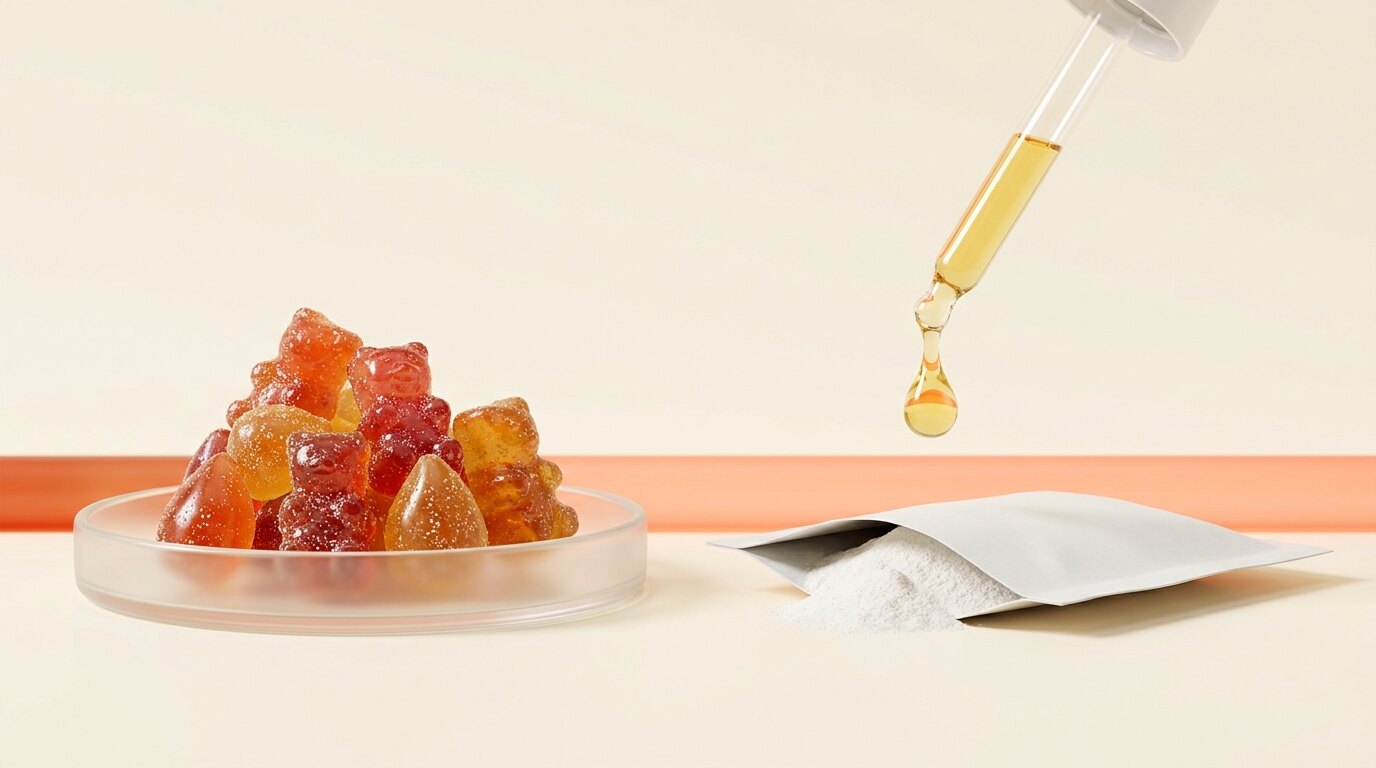
We'll be straight with you: we don't sell a gummy. triGLP is a dietary supplement delivered as sublingual drops built on bioactive salmon peptides, and IGNYT is a dissolvable sachet powder — both chosen to skip the added sugar and the shelf-stability tradeoffs of a candy matrix. Named ingredients, no proprietary-blend games. A supportive tool alongside good habits, not a drug.
See the triGLP drops// ships from the official ORYGN storefront · dietary supplement · not a drug · results vary
Red flags to walk away from
If a "GLP-1 gummy" does any of these, keep scrolling:
- "Natural Ozempic" / "works like semaglutide." No supplement has been shown to replicate a prescription GLP-1 drug, and the FDA warns that products marketed this way can be misbranded — even hiding undisclosed drug ingredients.5
- Disease or drug claims. "Treats diabetes," "melts fat," "guaranteed weight loss" — the FDA has issued warning letters treating GLP-1-claim products as unapproved new drugs.4 It's illegal for a supplement, and a sign the seller doesn't respect the rules or you.
- "Proprietary blend" with no doses. If they won't tell you how much of what is inside, you can't judge whether it's a real dose or fairy dust.
- A pile of sugar and a tiny active. Read the Supplement Facts and the sugar line before the health halo on the front.
The 5-point checklist
Hold any GLP-1 gummy — or any format — up to these five and you'll spot the honest ones fast:
- 1. Named ingredients with real evidence (protein/peptides, fermentable fiber, berberine) — not a mystery blend.
- 2. Disclosed doses you can compare to the research — and enough active to matter, not a sugar cube with a sprinkle.
- 3. Honest claims — "supports your body's own GLP-1," never "replaces the shot."
- 4. Format cost you're okay with — check the added sugar or sugar-alcohol line, and remember gummy potency can drift.6
- 5. Realistic framing — a modest, additive nudge used consistently, alongside diet and activity.
Why we chose drops over gummies
This is the honest reason we don't make a gummy. Two of them, really. First, the sugar: a product you take every day to support appetite shouldn't come wrapped in a daily dose of candy. Second, the delivery: our sublingual drops are designed to be held under the tongue, where the oral-mucosal (sublingual) route can let compounds enter circulation directly rather than being processed straight through the digestive tract — a well-studied delivery principle.8 A drop also lets us put a clean, named dose of bioactive salmon peptides in front of you without a sugar-and-gelatin shell in the way. Salmon protein peptides are among the most-studied marine peptides for appetite support, and there's early human data behind them.9 That's the tradeoff we made: fewer fun shapes, more honesty about what you're actually taking. Results vary.
The honest limits
A GLP-1 gummy — or a drop, or a powder — is a supportive nudge, not medicine. The effects of natural GLP-1 support are modest, build over time, vary from person to person, and much of the supporting research is preclinical (cell and animal models) with human studies that are small and early. No supplement replicates a prescription GLP-1 drug, and nothing here diagnoses, treats, cures, or prevents any disease. This page is educational, not medical advice — talk to your clinician, especially if you take medications. We link the studies so you can weigh the evidence yourself. Results vary.
Common questions
Do GLP-1 gummies actually work?
A gummy is a format, not an ingredient — so it "works" only to the extent it contains an evidence-backed ingredient (protein/peptides, fermentable fiber, or berberine) at a real, disclosed dose. Even then the effect is a modest, indirect nudge to your body's own GLP-1, not a drug-like result, and gummy potency can drift from the label. Judge the fill, not the shape. Results vary.
Are GLP-1 gummies the same as Ozempic or a "natural Ozempic"?
No. Prescription GLP-1 medications are drugs with large, direct effects and strong human clinical-trial evidence. No gummy or supplement has been shown to replicate them, and the FDA warns that products marketed as "natural Ozempic" can be misbranded or even hide undisclosed drug ingredients. Treat that phrase as a red flag. This page is educational, not medical advice.
Do you sell a GLP-1 gummy?
No — and we're upfront about why. triGLP is sublingual drops built on bioactive salmon peptides, and IGNYT is a dissolvable sachet powder. We chose those formats to avoid the added sugar of a gummy and the well-documented tendency of candy-matrix supplements to drift from their labeled potency. Fewer fun shapes, more honesty about the dose. Results vary.
Are gummy supplements less accurate than other formats?
They can be. A gummy is a moist, often acidic matrix that degrades faster than a tablet, and independent testing regularly finds contents that don't match the label — a 2023 JAMA analysis found 88% of tested melatonin gummies were inaccurately labeled, from 74% to 347% of the stated amount. Manufacturers often add large "overages" to compensate, which can leave a product over-dosed early and under-dosed later. It's a real quality-control challenge to weigh against the format's convenience.
References
- Boosting GLP-1 by Natural Products. 2021. pubmed.ncbi.nlm.nih.gov/34981502
- Proteins and Peptides from Food Sources with Effect on Satiety and Their Role as Anti-Obesity Agents: A Narrative Review. Nutrients, 2024. ncbi.nlm.nih.gov/pmc/articles/PMC11510221
- Protein- and Calcium-Mediated GLP-1 Secretion: A Narrative Review. Advances in Nutrition, 2021. pmc.ncbi.nlm.nih.gov/articles/PMC8634310
- Warning Letter — GLP-1 Solution (MARCS-CMS 715883). U.S. Food & Drug Administration, 2025. fda.gov — Warning Letter, GLP-1 Solution, 09/09/2025
- FDA's Concerns with Unapproved GLP-1 Drugs Used for Weight Loss. U.S. Food & Drug Administration. fda.gov/drugs — FDA's Concerns with Unapproved GLP-1 Drugs
- Cohen PA, Avula B, Wang Y, et al. Quantity of Melatonin and CBD in Melatonin Gummies Sold in the US. JAMA, 2023;329(16):1401–1402. pubmed.ncbi.nlm.nih.gov/37097362
- Nano Matrix Soft Confectionary for Oral Supplementation of Vitamin D: Stability and Sensory Analysis. 2022. ncbi.nlm.nih.gov/pmc/articles/PMC9140647
- Sublingual and Buccal Delivery: A Historical and Scientific Prescriptive. 2024. pmc.ncbi.nlm.nih.gov/articles/PMC12389210
- A Pilot Study of Salmon Protein Hydrolysate (ProGo®) Supplementation to Assess Its Impact on Hematologic, Integumentary and Metabolic Health. Biomedicines, 2026. doi.org/10.3390/biomedicines14081663