The GLP-1 booster, honestly
"GLP-1 booster" is a marketing phrase for any food or supplement sold to raise the GLP-1 your body already makes — the gut hormone behind fullness and steady blood sugar. Some of the levers are real. Many of the promises aren't. Here's what the published research actually shows about the ingredients you'll see on labels, what reliably works, and where the honest limits are — with sources.
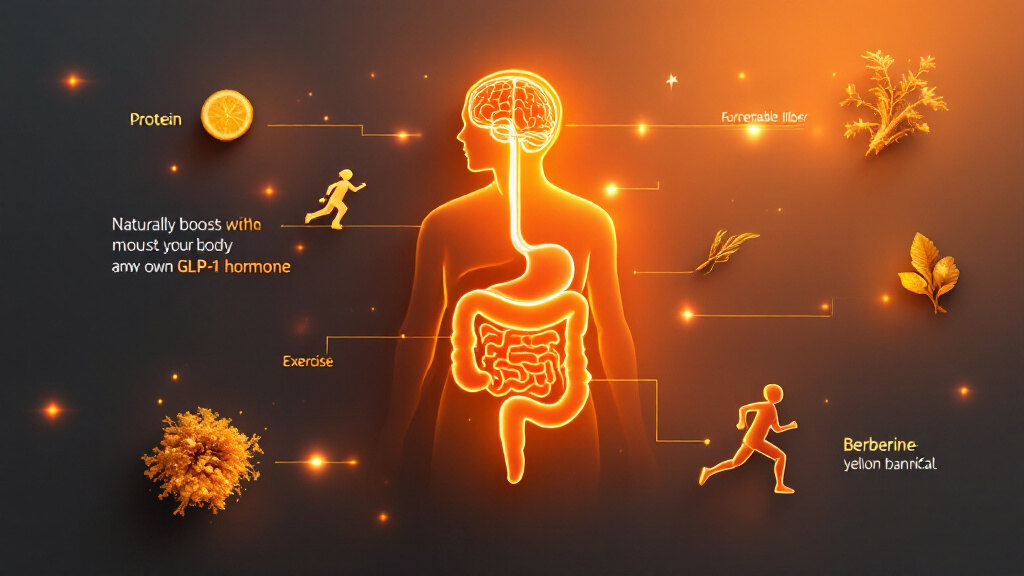
A few things genuinely nudge your body's own GLP-1 — most reliably protein, fermentable fiber, and regular exercise.237 Some plant compounds sold as "boosters," like berberine, do stimulate GLP-1 in lab and animal studies.15 But these effects are indirect, modest, mostly early-stage, and nowhere near a prescription GLP-1 drug. A "GLP-1 booster" supports a system you already run — it doesn't replace medicine. Not a drug. Talk to your clinician, especially about berberine's drug interactions. Results vary.
On this page
What a "GLP-1 booster" means
GLP-1 — glucagon-like peptide-1 — is a hormone your gut's enteroendocrine L-cells release when you eat. It tells your brain you're full, slows stomach emptying, and helps steady blood sugar.2 A "GLP-1 booster" is simply any food, nutrient, or supplement marketed to increase how much of that hormone you make. The honest framing: you're not adding a drug — you're trying to coax more out of a system you already have. Some inputs really do turn that dial. Others are hype riding a popular search term.1
"A real GLP-1 booster doesn't override your biology — it feeds the switch your gut already flips every time you eat."
The ingredients on the label
Scan any "GLP-1 booster" supplement and you'll usually see some mix of the following. A recent review of natural products that influence GLP-1 catalogs many of them — and is candid that most evidence is preclinical.1
- Protein / protein peptides: the best-supported dietary trigger — high-protein meals produce the largest GLP-1 response, and food-derived peptides can act directly on L-cells.3
- Fermentable fiber (β-glucan, inulin, psyllium): gut bacteria ferment it into short-chain fatty acids that signal GLP-1-producing cells — a real, if slow, lever.4
- Berberine: the plant alkaloid with the most GLP-1 research behind it (details below).56
- "Bitter" compounds: some boosters lean on bitter-taste-receptor pathways in the gut, which can trigger GLP-1 release — the same pathway berberine partly uses.6
Berberine: what the research shows
Berberine is the ingredient most responsible for the "natural GLP-1" buzz, and it does have real mechanistic evidence — but read it carefully. In studies, five weeks of berberine enhanced glucose-triggered GLP-1 secretion, boosted proglucagon gene expression, and even increased L-cell numbers in the gut; in the lab it stimulated GLP-1 release from intestinal cells in a dose-dependent way.5 Part of how it works is by activating bitter-taste-receptor pathways in the gut.6 The crucial caveat: most of this is in cells and animals, the human data is thin, and any effect is far smaller and less direct than a prescription GLP-1 medication.1 Berberine is promising, not proven, for this use.
Where salmon peptides fit
triGLP is a dietary supplement built on bioactive salmon peptides — food-derived protein fragments studied for supporting the body's own GLP-1 signaling. It's designed to sit alongside good habits, not to act like a drug or replace them.
See the triGLP drops// ships from the official ORYGN storefront · dietary supplement · not a drug · results vary
What reliably boosts GLP-1
If you want the levers with the strongest, most consistent evidence — the ones that don't depend on a supplement at all — they're refreshingly ordinary:
- Protein at every meal. High-protein meals stimulate the biggest GLP-1 response versus equal-calorie fat or carbs, with dairy, egg, and fish protein noted as strong triggers.3
- Fermentable fiber, daily. Oats and barley (β-glucan), legumes, and resistant starch feed the gut bacteria that make short-chain fatty acids — the signal that raises GLP-1 over time.4
- Regular exercise. In a randomized trial, a year of exercise after weight loss increased the late post-meal GLP-1 response by about 37% versus usual activity.7
The honest nuance: these are consistency plays, not quick spikes. When researchers acutely bumped colonic short-chain fatty acids with inulin, GLP-1 didn't jump in the short term8 — a good reminder that "booster" results come from a pattern held over weeks, not one dose.
Boosters vs. GLP-1 drugs
This is the comparison the search term is really chasing, so let's be blunt. Prescription GLP-1 medications are engineered drugs, dosed to strongly and directly activate the GLP-1 receptor, with large human clinical-trial evidence behind them. Natural "boosters" work on the same hormone family but only indirectly, through your body's own release, at a much smaller scale — and reviews caution that treating them as equivalent alternatives is misleading.1 A booster is a supportive nudge, not a substitute for medication.
A safety word on berberine
Berberine isn't a harmless "just a plant" supplement. It can interact with a number of prescription medications — including some diabetes drugs, statins, and blood thinners — because it affects the same liver enzymes that process them. If you take any prescription medication, or you're pregnant or nursing, talk to your clinician before starting berberine or any GLP-1 booster. This page is educational, not medical advice.
The honest limits
Some GLP-1 boosters are backed by real mechanisms — protein, fermentable fiber, and exercise most solidly, with berberine as a promising-but-early plant compound. But the effects are modest, they build over time, much of the supplement evidence is preclinical, and nothing here replicates a prescription GLP-1 drug. These are dietary supplements and food habits, not medicine — they do not diagnose, treat, cure, or prevent any disease. This page is educational, not medical advice; we link the studies so you can weigh them yourself. Results vary.
Common questions
Do GLP-1 boosters actually work?
Some levers do nudge your body's own GLP-1 — protein, fermentable fiber, and regular exercise have the strongest, most consistent evidence, and berberine has real lab and animal data. But the effects are modest and indirect, much of the supplement research is preclinical, and none of it matches a prescription GLP-1 drug. Boosters support a system you already run; they don't replace medicine. Results vary.
Is berberine a natural GLP-1 booster?
It's the plant compound with the most GLP-1 research behind it — studies show it can enhance GLP-1 secretion, raise proglucagon expression, and increase gut L-cell numbers, partly via bitter-taste-receptor pathways. The catch: most of that is in cells and animals, human data is limited, and the effect is far smaller than a drug. It's promising, not proven, for this use — and it can interact with medications, so check with your clinician first.
What's the most reliable way to boost GLP-1?
Diet and movement, not a pill: protein at each meal (the biggest dietary GLP-1 trigger), fermentable fiber daily (oats/barley β-glucan, legumes, resistant starch, which raise GLP-1 through gut bacteria over time), and regular exercise, which increased the post-meal GLP-1 response by about 37% over a year in one trial. These are consistency plays, not quick spikes. Results vary.
Can a GLP-1 booster replace Ozempic or a prescription?
No. Prescription GLP-1 medications are drugs with strong human clinical-trial evidence and large, direct effects. Natural boosters work on the same hormone family but indirectly and far more gently, and reviews specifically warn against treating them as equivalent alternatives. A booster is a supportive nudge, not a substitute for medication. This page is educational, not medical advice.
References
- Boosting GLP-1 by Natural Products. 2021. pubmed.ncbi.nlm.nih.gov/34981502
- Nutritional modulation of endogenous glucagon-like peptide-1 secretion: a review. Nutrition & Metabolism, 2016. pmc.ncbi.nlm.nih.gov/articles/PMC5148911
- Protein- and Calcium-Mediated GLP-1 Secretion: A Narrative Review. Advances in Nutrition, 2021. pmc.ncbi.nlm.nih.gov/articles/PMC8634310
- Arabinoxylan as well as β-glucan in barley promotes GLP-1 secretion by increasing short-chain fatty acids production. 2022. ncbi.nlm.nih.gov/pmc/articles/PMC9482107
- Modulation of glucagon-like peptide-1 (GLP-1) release by berberine: in vivo and in vitro studies. 2010. pubmed.ncbi.nlm.nih.gov/19945441
- Berberine induces GLP-1 secretion through activation of bitter taste receptor pathways. 2015. pubmed.ncbi.nlm.nih.gov/26206195
- One Year of Exercise After Weight Loss Increases Postprandial GLP-1 Secretion in Contrast to Usual Activity or GLP-1 Receptor Agonist Treatment. 2025. pubmed.ncbi.nlm.nih.gov/40998556
- Acute increases in serum colonic short-chain fatty acids elicited by inulin do not increase GLP-1 or PYY responses but may reduce ghrelin in lean and overweight humans. 2017. pubmed.ncbi.nlm.nih.gov/27966574