Best protein for weight loss the honest comparison
Ask ten fitness feeds and you'll get ten different 'best' proteins. The research tells a calmer story: getting enough protein matters far more than crowning a single winner — and the differences between good sources are smaller than the marketing suggests. Here's what the studies actually show about whey, fish, eggs and plant proteins for weight management, and how to pick yours.
There is no single 'best' protein for weight loss — the evidence supports eating enough protein, from sources you genuinely enjoy, spread across your meals 16. Whey digests fast and supports fullness signals, fish (including salmon) performed well in a randomized weight-loss trial, a protein-rich breakfast calms hunger hormones, and legumes bring fiber along for the ride 34. The best protein is the one that keeps you satisfied on a normal, sustainable plate.
On this page
Why protein pulls so much weight in weight management
Three reasons protein earns its reputation. First, satiety: higher-protein meals reliably rate as more filling, and reviews of the evidence link higher protein intakes with better appetite control during weight loss 16. Second, the thermic effect: your body spends more energy digesting protein — roughly 20–30% of protein's calories — than it spends on carbs or fat 5. Third, muscle: in a meta-analysis of energy-restricted diets, higher-protein versions preserved more lean mass and lost more fat mass than standard-protein versions 2.
None of this makes protein magic. It makes it a structural advantage: meals built around protein tend to keep you fuller on the same calories, which makes a sustainable deficit feel less like a fight 1.
"Enough protein, from foods you'll actually keep eating, beats the 'perfect' protein you abandon in a week."
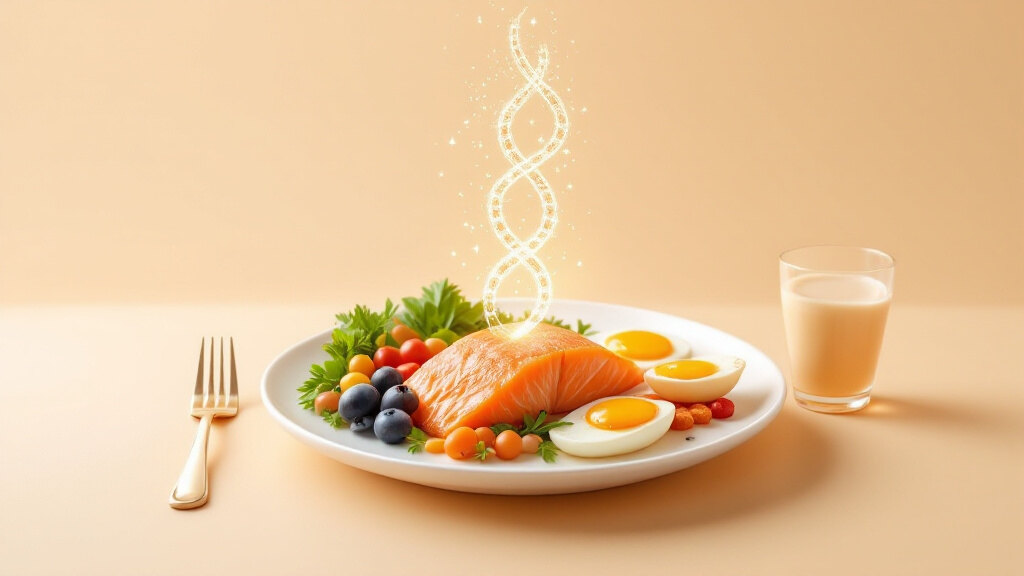
Whey, fish, eggs, plants — the honest comparison
Whey digests quickly, is rich in essential amino acids, and is one of the most-studied proteins for appetite — protein intake influences gut hormones tied to fullness, including GLP-1 and ghrelin 7. It's convenient, but it's a supplement to a plate, not a replacement for one.
Fish deserves more attention than it gets. In a randomized weight-loss trial in young adults, diets that included fish (cod or salmon) or fish oil produced greater weight loss in men than an otherwise-equal diet without seafood 4. Salmon in particular brings protein plus omega-3 fats in one package.
Eggs and other breakfast proteins shine early in the day: a high-protein breakfast blunted the post-meal rise of ghrelin — the 'I'm hungry' hormone — more than a high-carb one 3. And plant proteins like lentils, beans and chickpeas arrive with fiber built in, which supports fullness through a second, complementary route 1.
How much, and when
Reviews of higher-protein weight-loss diets generally land around 1.2–1.6 grams of protein per kilogram of body weight per day for appetite and body-composition benefits — for a 175-pound (80 kg) adult, roughly 95–130 grams spread across the day 1.
Distribution matters more than perfect timing: aim for a meaningful serving of protein at each meal rather than one giant dinner. Front-loading some of it at breakfast is a research-backed way to quiet mid-morning hunger 3. And pick sources you can repeat for months — consistency is the mechanism, not novelty 6.
Where salmon peptides fit
Whole-food protein does the heavy lifting for fullness. Alongside it, some people explore bioactive peptides — short protein fragments studied for how they interact with the body's own appetite signaling. triGLP is a sublingual drop made from salmon-derived peptides, formulated to support your body's natural satiety pathways — the same gut-hormone routes (like GLP-1) that respond to the protein on your plate 7.
It's a dietary supplement, not a medication, and it doesn't replace protein, fiber, sleep or movement — those fundamentals still set the outcome. Research on salmon peptides specifically is still early, and results vary from person to person. Think of it as one supporting piece of a protein-forward routine, not a shortcut.
Salmon peptides you can actually take
triGLP is bioactive salmon peptides in four clean, sublingual ingredients — support your body's own pathways, from a drop, not a needle.
See the triGLP drops// ships from the official ORYGN storefront · dietary supplement · not a drug · results vary
The honest limits
Much of the research on food-derived salmon and fish peptides is early — cell and animal models plus small human studies. Encouraging signals are not proof for any individual. Salmon peptides are a dietary supplement, not a medicine; they don't treat any condition, they won't override your biology, and results vary. If you're managing a health matter, decide based on your own situation. The studies are linked below so you can read them yourself.
Common questions
Is whey or plant protein better for weight loss?
Both can work. Whey is fast-digesting and rich in essential amino acids; plant proteins like legumes bring fiber that supports fullness through a second route 17. Reviews suggest total daily protein and consistency matter more than the specific source 6. Pick the one you'll actually keep eating.
How much protein should I eat per day to lose weight?
Research on higher-protein weight-loss diets commonly lands around 1.2–1.6 g per kg of body weight daily — about 95–130 g for an 80 kg (175 lb) adult — spread across meals rather than loaded into one 1. Individual needs vary; a registered dietitian can personalize this.
Does protein really burn more calories?
Digesting protein costs your body more energy than digesting carbs or fat — roughly 20–30% of protein's calories go to processing it, versus about 5–10% for carbs 5. It's a real but modest effect; the bigger lever is that protein-rich meals help you feel full on fewer calories 1.
Is salmon good for weight loss?
Salmon offers protein plus omega-3 fats, and in a randomized trial, weight-loss diets that included fish such as salmon produced greater weight loss in men than an equal-calorie diet with no seafood 4. As part of a balanced pattern, it's one of the stronger whole-food protein choices.
References
- The role of protein in weight loss and maintenance. Leidy HJ, et al. Am J Clin Nutr, 2015;101(6):1320S-1329S. pubmed.ncbi.nlm.nih.gov/25926512
- Effects of energy-restricted high-protein, low-fat compared with standard-protein, low-fat diets: a meta-analysis of randomized controlled trials. Wycherley TP, et al. Am J Clin Nutr, 2012;96(6):1281-1298. pubmed.ncbi.nlm.nih.gov/23097268
- Effect of a high-protein breakfast on the postprandial ghrelin response. Blom WA, et al. Am J Clin Nutr, 2006;83(2):211-220. pubmed.ncbi.nlm.nih.gov/16469977
- Randomized trial of weight-loss-diets for young adults varying in fish and fish oil content. Thorsdottir I, et al. Int J Obes (Lond), 2007;31(10):1560-1566. pubmed.ncbi.nlm.nih.gov/17502874
- Diet induced thermogenesis. Westerterp KR. Nutr Metab (Lond), 2004;1(1):5. ncbi.nlm.nih.gov/pmc/articles/PMC524030
- Are Dietary Proteins the Key to Successful Body Weight Management? A Systematic Review and Meta-Analysis. Nutrients, 2021;13(9):3193. pubmed.ncbi.nlm.nih.gov/34579069
- Effect of short- and long-term protein consumption on appetite and appetite-regulating gastrointestinal hormones, a systematic review and meta-analysis. Physiol Behav, 2020;226:113123. pubmed.ncbi.nlm.nih.gov/32768415